Britain Shot Down a Russian Drone Over Ukraine. Or It Didn't.
What happened
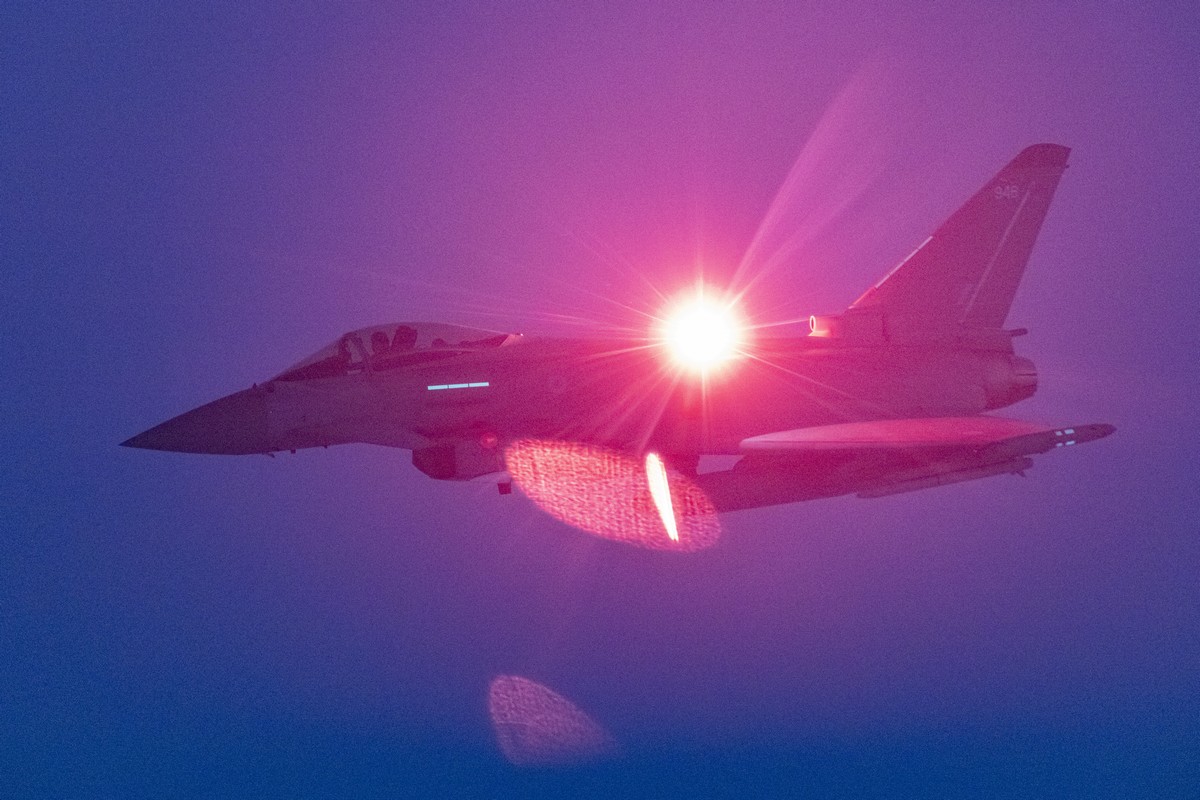
In the early hours of April 25, Russian forces conducted drone strikes on Ukrainian infrastructure near the Danube River, close to Romania's border. Romania's Ministry of National Defence confirmed that two RAF Eurofighter Typhoons assigned to NATO's Enhanced Air Policing mission scrambled from Fetesti air base at 02:00, made radar contact with a target 1.5 kilometers from Reni in Ukrainian airspace, and were authorized to engage. Drone fragments subsequently fell in the Galati district of Romania, damaging a structure and an electricity pole. Romania's official statement and multiple media reports describe this as the first time a NATO aircraft shot down a Russian drone over Ukrainian territory. The UK Ministry of Defence issued a contradictory statement confirming the scramble but saying both aircraft returned to base without engaging any Russian assets and did not enter Ukrainian airspace. The ceasefire market currently prices a Russia-Ukraine ceasefire by May 31 at 5% probability.
The fact that Romania and Britain issued flatly contradictory official accounts of the same incident, with fragments landing in Romania regardless, is more alarming than either account alone: it means NATO's command structure either did something significant and is hiding it, or failed to communicate what happened within its own alliance for hours.
Prediction Markets
Prices as of 2026-04-25 — the analysis was written against these odds
The Hidden Bet
One account is correct and the discrepancy is just a miscommunication
Romania's account is specific and operational: 02:00 takeoff, 02:31 resident reports of falling objects, fragments identified in multiple locations, damage confirmed by inspectors. That level of detail does not fit a miscommunication about whether shots were fired. The UK statement using words like 'standard monitoring procedure' suggests the two governments made a deliberate choice to describe the same event differently, which implies a political decision about what to acknowledge.
NATO engagement over Ukrainian territory would represent a major escalation threshold
NATO aircraft have been operating in Romanian airspace adjacent to Ukrainian territory for over two years. The Typhoons were authorized to engage under NATO's enhanced air policing rules specifically to protect Romanian airspace. A drone at 1.5 km from the Romanian border, flying toward it, may fall well within the operational parameters that have already been quietly established. The 'first' framing assumes a threshold exists that the alliance may have already decided to treat as crossed.
Russia will respond in kind if its drone was downed by NATO forces
Russia has calibrated its response to every escalation in this war to avoid direct NATO engagement. The Kremlin has consistently absorbed Ukrainian strikes on Russian territory with statements rather than retaliation against NATO assets. There is no evidence Russia treats the loss of a single Shahed drone as a casus belli for direct confrontation with Britain.
The Real Disagreement
The real fork is between two positions both held by serious people: NATO aircraft protecting alliance airspace should have the authority to engage any drone threatening to cross the Romanian border, regardless of where it is at the moment of engagement, because waiting until it crosses means waiting until it causes damage. The opposing view is that any NATO military action over Ukrainian territory, however brief, erases a distinction that has kept this war from becoming a direct NATO-Russia war, and erasing it unilaterally without alliance consensus is precisely how conflicts expand in ways nobody intends. The second view is harder to dismiss than it looks, because the mechanism of escalation in every major 20th century war was not a planned decision but a series of individual actions each of which seemed locally justified. What tips the analysis toward the first view is that Russia has already been operating drones within 1.5 km of NATO territory for two years without triggering the response it claimed would constitute an act of war.
What No One Is Saying
The drone that fell in Galati fell in Romania regardless of whether the RAF shot it down or not. Russia's attacks on Ukrainian infrastructure near the border have been landing in NATO territory intermittently for months. The question of whether Britain shot down a Russian drone is less important than the question of why Russian weapons keep landing on NATO soil and whether that has already constituted a threshold no one wants to name.
Who Pays
Border communities in Romania and Moldova
Ongoing and worsening as Russian attack patterns continue
Drone fragments from Russian attacks on Ukrainian infrastructure near the Danube regularly fall across the border. These communities absorb the physical damage and psychological cost of living in what is effectively a war zone while technically being under NATO protection
NATO's air policing pilots
Next incident
If the alliance has quietly authorized engagement over Ukrainian territory but is not publicly acknowledging it, pilots operate under rules of engagement that will be disavowed if anything goes wrong. The UK's contradictory statement is a preview of what that disavowal looks like
Scenarios
Quiet Normalization
The contradictory accounts are never reconciled. NATO continues to authorize border-adjacent engagements without publicizing them. Russia continues to absorb the losses without formal escalation. The threshold shifts gradually without anyone having to defend it.
Signal No formal Russian diplomatic protest, no UK parliamentary statement clarifying what happened, incident fades from coverage within 72 hours
Russia Escalates the Framing
Russia treats the incident as a NATO attack on a Russian asset and uses it as justification for a significant strike on a non-Ukrainian target, or a diplomatic ultimatum to NATO members hosting these missions. The UK's denial becomes the central issue rather than a side note.
Signal A formal Russian diplomatic communique to the UK or Romania within 48 hours citing this specific incident
Alliance Fracture
The UK and Romania cannot reconcile their accounts publicly, and other alliance members demand clarity on what the rules of engagement actually are and who authorized expanding them. The incident triggers an emergency NATO consultation that leaks, revealing that smaller members have been operating under different assumptions than larger ones.
Signal An emergency session of the NATO Military Committee called within two weeks, or a public statement from a non-UK, non-Romanian NATO member demanding clarification
What Would Change This
If the UK MoD confirms that the aircraft did engage, or if Russia formally acknowledges the incident and escalates, the analysis moves from 'ambiguous threshold event' to 'confirmed direct engagement,' which has different strategic weight. The current situation is genuinely ambiguous.
Related
Russia's Victory Day Ceasefire Is Already Over
conflictEurope Is Trying to Win a War the US Stopped Funding
conflictRussia Lost Ground in April. Ukraine Is Striking Oil Refineries 1,600 Kilometers Deep.
conflictEurope Just Had Its Biggest Military Spending Surge Since 1953. It Is Not Enough and Everyone Knows It.