Europe Is Trying to Win a War the US Stopped Funding
What happened
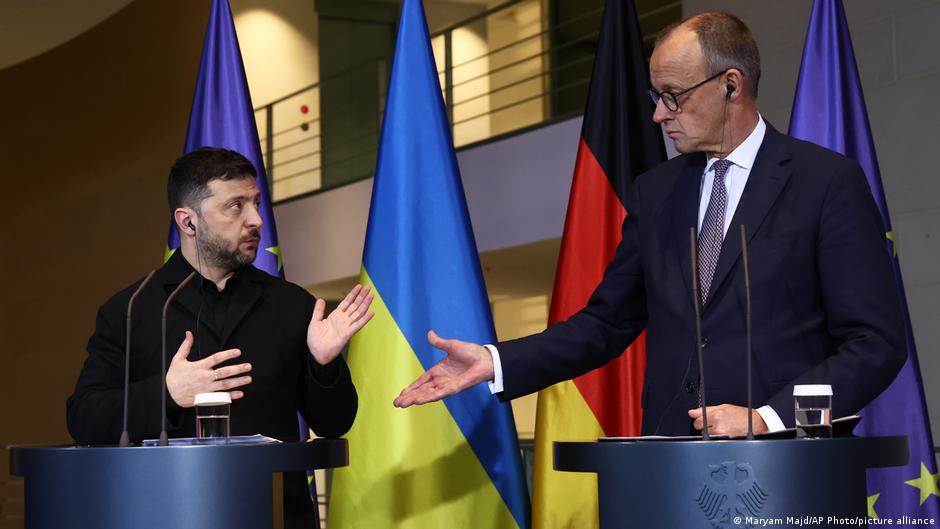
Ukrainian President Zelenskyy made a surprise visit to Berlin on April 14 for the first full German-Ukrainian government consultations in over 20 years. Germany and Ukraine signed 10 bilateral agreements covering air defense (PAC-2 Patriot missiles, IRIS-T systems), long-range weapons, drones, and ammunition, with joint production of 7 drone types announced. Chancellor Merz declared Germany Ukraine's top European supporter and said Europe must be involved in any US-Russia peace talks: no deal 'over the heads of Europeans.' Zelenskyy explicitly rejected 'EU-light' or 'NATO-light' membership, demanding full integration. With Hungarian Prime Minister Orban's electoral defeat over the weekend, the path to a previously blocked EU 90 billion euro loan to Kyiv appears clear, potentially as early as next week's Cyprus summit.
Germany is now structurally replacing the US as Ukraine's primary backer, and the Orban defeat removes the last veto on the EU loan. But the ceasefire markets tell you what this all means: 10.5% chance of a pause by June 30. Zelenskyy is building a war economy, not a peace process.
Prediction Markets
Prices as of 2026-04-14 — the analysis was written against these odds
The Hidden Bet
The EU loan unlocking changes Ukraine's position at the negotiating table
The 90 billion euro loan is expected to go two-thirds directly to Ukraine's armed forces to maintain battle-readiness through 2027. This is not reconstruction money or leverage for compromise. It is the signal that Europe has committed to sustaining the war for at least two more years, which makes Putin's incentive to negotiate worse, not better.
Zelenskyy's rejection of NATO-light is a negotiating position
Lithuania, Estonia, and Latvia have been explicit that any form of diluted membership leaves Ukraine permanently vulnerable and creates a template Russia can exploit elsewhere. For Eastern European states that lived under Soviet occupation, this is not a negotiating position. It is a red line they have stated clearly and consistently for three years.
Germany's drone deal is primarily about Ukraine's defense
Merz said directly: 'What we are doing in this cooperation is not only beneficial for Ukraine's defense. It is also of particular benefit to us, for our security.' Germany is using Ukraine as an R&D laboratory and production partner for drone warfare that its own Bundeswehr will need. The deal is as much about rearming Germany at speed as it is about helping Kyiv.
The Real Disagreement
The actual fork is between two security architectures that cannot coexist. The first: a negotiated settlement where Ukraine accepts frozen lines in exchange for some form of security guarantee and eventual, if slow, EU integration. The second: Ukrainian full membership in both blocs as a precondition for any durable peace, backed by enough European military capability to make Russian recalculation credible. The first path requires Ukraine to trade territory for peace and trust that a piece of paper will hold. The second requires Europe to build a war-fighting deterrent within 3-5 years that it currently does not have. The market pricing at 10.5% ceasefire odds by June 30 and 29.5% by end of year suggests money is betting on neither path resolving quickly. I lean toward the second architecture being correct strategically, but the EU does not yet have the industrial base or political consensus to execute it, which makes the actual outcome likely to be neither: a prolonged frozen conflict with episodic violence.
What No One Is Saying
Germany needs Ukrainian military knowledge more than Ukraine needs German money. The Bundeswehr has not fought a peer adversary in 80 years. Ukraine has 1,511 days of continuous innovation in drone warfare, electronic warfare, and counter-battery tactics against a nuclear state. The Berlin consultations are as much a technology transfer from east to west as the reverse.
Who Pays
Ukrainian men aged 18-25
The political pressure is immediate; draft extension is a 2026 decision
Germany explicitly complained to Zelenskyy about Ukrainian men of draft age arriving in Berlin as refugees and asked Kyiv to stop the flow. Ukraine has conscription for men 25 and over. The gap means younger men are leaving the country legally. The Berlin deal deepens Ukraine's commitment to the war, increasing pressure on Kyiv to extend the draft downward.
European taxpayers
The loan structure question will surface within 3 years
The 90 billion euro EU loan to Ukraine will eventually need to be repaid or absorbed. Two-thirds goes directly to military spending. There is no plausible reconstruction scenario in which Ukraine repays this without either massive asset sales or long-term EU budget transfers. The 'loan' framing is diplomatic fiction.
US position in any peace talks
Immediate: the US-Russia-Ukraine triangle is already collapsing into two separate tracks
Every bilateral agreement Germany and Ukraine sign without US involvement weakens Trump's leverage as a mediator. Russia will not accept a peace deal whose security guarantees are backstopped by a European framework that explicitly excludes US participation. Merz said no deal 'over the heads of Europeans'; Trump has been trying to cut a deal without European input for months.
Scenarios
War Continues, Europe Expands Support
EU loan unlocks, Germany drone production scales, US-Russia bilateral talks produce a framework Ukraine rejects. War continues at current intensity through 2027. European security architecture deepens but without formal NATO expansion.
Signal Cyprus EU summit approves the 90 billion euro disbursement next week without conditions
Trump Forces Frozen Conflict
US threatens to withdraw intelligence sharing unless Ukraine accepts a ceasefire on current lines. Zelenskyy refuses. US partially withdraws. Europe cannot fill the intelligence gap. Ukraine accepts a temporary halt.
Signal US suspends satellite imagery sharing or imposes a weapons delivery pause as leverage
Russia Collapses Negotiations Entirely
Russia escalates with a major offensive in Sumy to force a negotiating advantage before the EU loan clears. Europe responds with expedited weapons deliveries. Ceasefire probability drops to near zero for 2026.
Signal Russian forces breach the Sumy region line in a sustained push of more than 10 kilometers
What Would Change This
If the market's 10.5% ceasefire by June 30 is wrong, the signal would be a joint US-Russia declaration of a 30-day unilateral pause with European endorsement. That requires Trump to deliver something Russia agrees to without European input, which is exactly what Merz just said Europe will block. The bottom line holds unless the US overrides European objections, which is possible but would fracture the Atlantic relationship further.
Related
Merz's Trade: Give Russia the Land, Get Ukraine into the EU
conflictPutin Proposed His Friend Schroeder as Ukraine Mediator. Every Party That Matters Rejected Him Within 24 Hours.
conflictRussia's Victory Day Ceasefire Is Already Over
conflictEurope Just Had Its Biggest Military Spending Surge Since 1953. It Is Not Enough and Everyone Knows It.