Europe Just Had Its Biggest Military Spending Surge Since 1953. It Is Not Enough and Everyone Knows It.
What happened
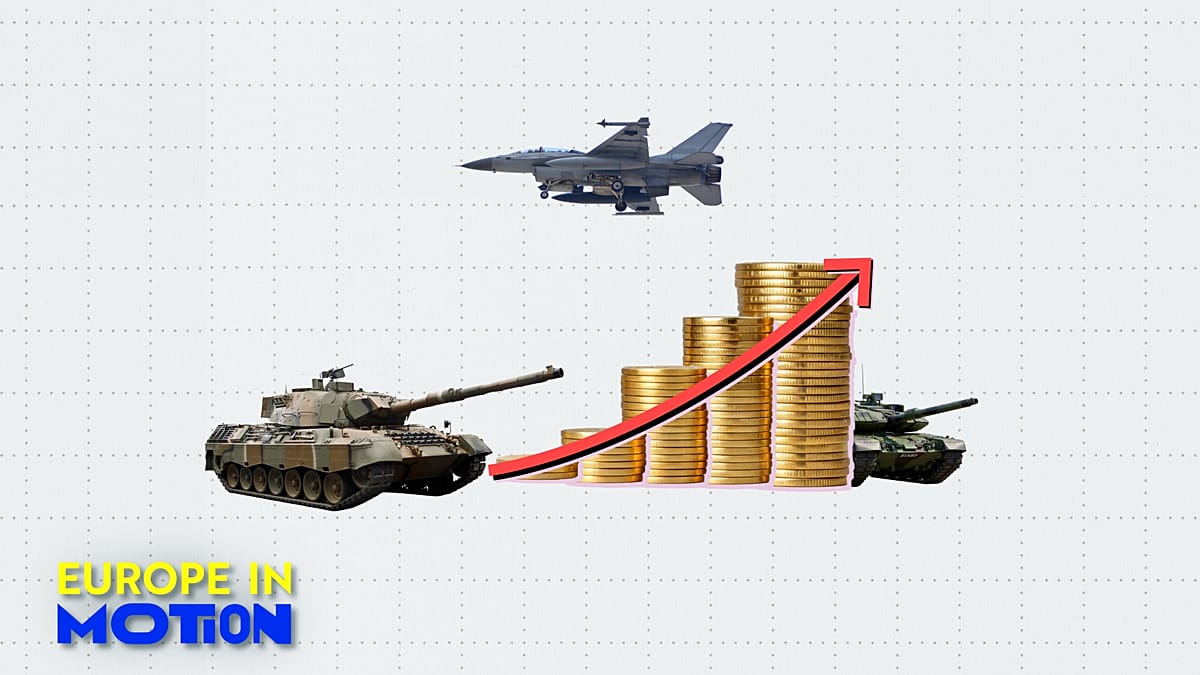
The Stockholm International Peace Research Institute published its annual report this week showing European NATO members grew defense spending 14% in 2025, the fastest single-year increase since 1953. Total world defense spending hit $2.887 trillion, the 11th consecutive annual record. Germany spent 97 billion euros, a 24% increase, overtaking the UK to become Europe's largest defense spender. The jump came as US defense spending fell 7.5% after Washington halted military aid to Ukraine. NATO has set a new internal target of 5% of GDP for members by 2035, roughly double the current 2% target. Most European members are still below even the 2% level.
Europe is rearming at a pace not seen since the early Cold War, but the math does not close: the new 5% NATO target would require most European economies to more than double their current military budgets, and they are doing it while simultaneously trying to fund social welfare states and transition off Russian energy.
Prediction Markets
Prices as of 2026-05-01 — the analysis was written against these odds
The Hidden Bet
Higher defense spending translates into usable military capacity quickly
Defense industrial bases cannot scale in a year. European ammunition production is still well below wartime demand levels. Germany's 97 billion euro budget includes significant legacy personnel and infrastructure costs. The gap between spending and deployable fighting capability takes years to close, and the threat timeline from Russia is not waiting for European procurement cycles.
The 14% spending surge reflects a durable political commitment across European governments
The surge happened under governments that were already under voter pressure. Center-right and nationalist parties that are skeptical of Ukraine support and open to deal-making with Russia are gaining ground in Germany, France, and several Eastern European states. A government change in any major NATO member could reverse the spending trajectory quickly.
The US 7.5% defense spending drop is a temporary policy choice that will reverse
The US drop came from halting Ukraine aid, which Trump framed as permanent strategic reorientation, not budget tightening. If the US continues pulling back from European security commitments, the 5% GDP target is not a political aspiration but a survival calculation that assumes America is effectively gone from European defense.
The Real Disagreement
The real disagreement is not whether Europe should spend more on defense. It is whether the spending surge is building genuine deterrence or buying political reassurance. The deterrence argument: Russia is in an active war, defense spending signals resolve, and European credibility requires capability. The political reassurance argument: most of what is being spent goes to personnel, legacy equipment, and procurement contracts that won't deliver usable capability for five to ten years. The spending announcement is the product, not the military capability it supposedly buys. Both things can be true simultaneously: the political signal matters even if the capability gap persists. But the NATO 5% target is built on the assumption that European economies can double military spending without destabilizing their fiscal positions. Germany is already running significant deficits to fund this. There is a real constraint here that the rhetoric is outrunning.
What No One Is Saying
The US drew down European defense spending by halting Ukraine aid and threatening NATO withdrawal. European countries responded by increasing their own spending faster than at any point since 1953. If the goal was to get Europe to pay for its own defense, the Trump approach is working. The question nobody is asking publicly is whether a Europe that pays its own defense bills will remain as deferential to US strategic priorities as it was when it was a US dependent.
Who Pays
German taxpayers and social service recipients
Ongoing, fiscally visible by 2027
Germany is funding the defense surge partly through debt and partly by compressing social spending. The 97 billion euro defense budget represents a structural shift in the German fiscal model that was constitutionally prohibited until the debt brake was suspended
Ukraine
Immediate; the divergence is already visible in SIPRI data
European defense spending surge is partly driven by the Ukraine war but is mostly going toward domestic capability, not Ukraine support. The gap between European defense spending and European Ukraine aid remains large, and the spending surge does not automatically translate into more weapons for Kyiv
Eastern European NATO members
Ongoing
Poland is spending 5% of GDP on defense and is essentially building the eastern flank of NATO's deterrence alone. The Baltic states and Poland are absorbing real fiscal pain while larger Western European economies are still building toward the 2% target
Scenarios
Credible Deterrence Emerges
European spending surge translates into deployable capability by 2028-2029. Russia's calculus shifts, conflict stays frozen, and NATO's eastern flank is genuinely defensible without US troops. Europe becomes a strategic peer rather than a dependent.
Signal Watch for NATO to certify multiple European members at combat-ready status for eastern deployment, not just spending targets met on paper.
Fiscal Backlash
Voter pressure over defense spending redirecting from social programs produces government changes in Germany, France, or Italy within the next two electoral cycles. Spending plateaus below the 5% target. The gap between announced commitment and actual capability widens.
Signal Watch for polling in Germany and France showing voters ranking defense spending as a top grievance alongside cost of living. The AfD in Germany already runs on this.
Strategic Decoupling
Europe reaches sufficient self-reliance that it begins making independent strategic choices that diverge from Washington. This could mean a separate European deal with Russia over Ukraine, independent nuclear deterrence discussions involving Germany, or European arms sales to actors the US opposes.
Signal Watch for France or Germany to make a public diplomatic move on Ukraine without US coordination. That would signal the decoupling has started.
What Would Change This
A Russian ceasefire agreement in Ukraine that holds for six months would reduce the political pressure sustaining the spending surge. Several European governments are spending at current levels in direct response to active war on the continent. A frozen conflict changes the calculation for legislatures that need to justify the fiscal pain.
Related
Europe Is Taking Over NATO. Washington Hasn't Noticed It's Losing the Alliance.
conflictTrump Pulls 5,000 Troops from Germany. NATO's Eastern Flank Is Now Improvising.
power184 Sanctioned Russian Ships Passed Through UK Waters. None Were Boarded.
conflictEurope Is Trying to Win a War the US Stopped Funding