The Memorial That Normalizes a New Alliance
What happened
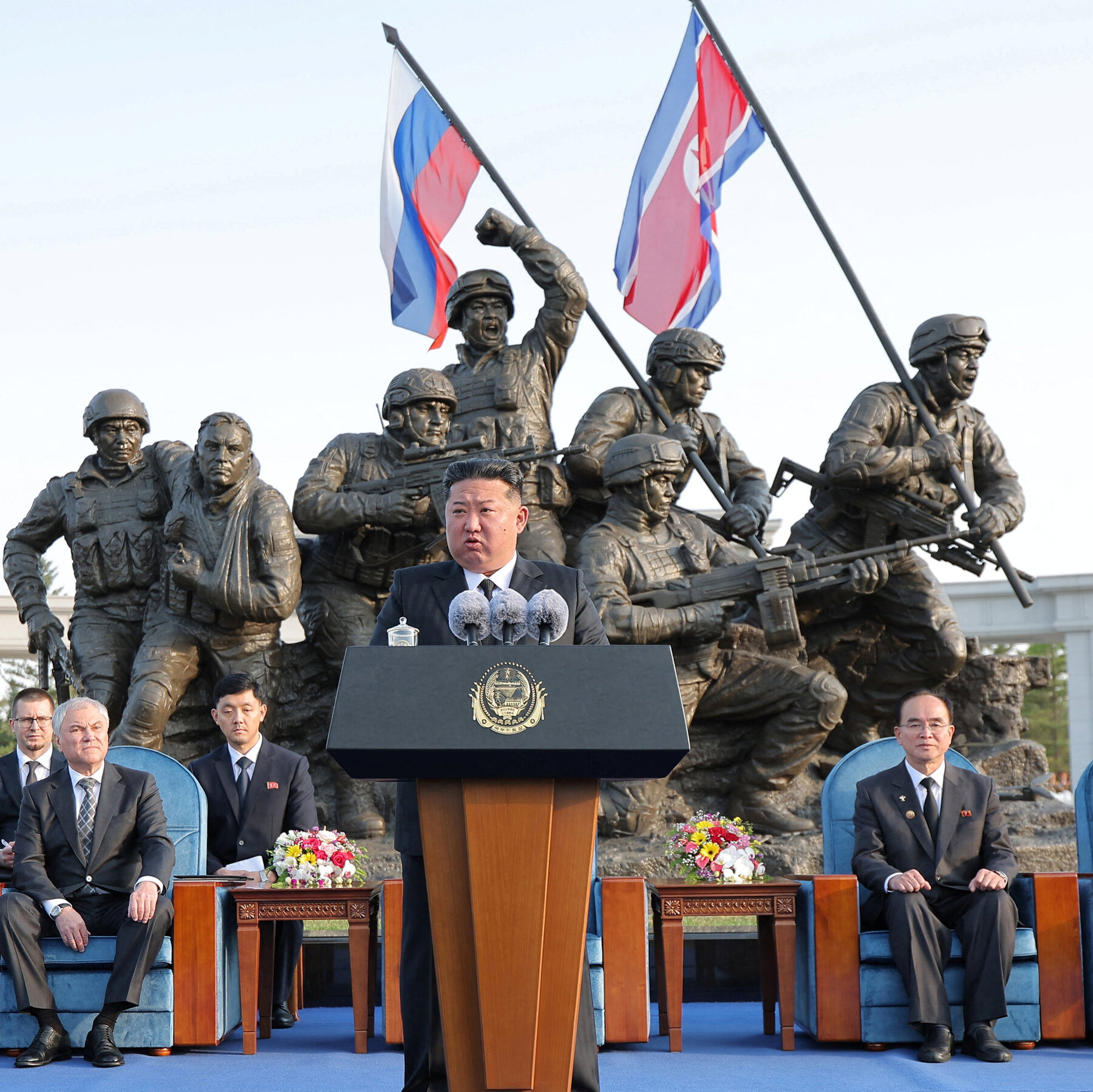
North Korean leader Kim Jong Un and Russian Defense Minister Andrey Belousov opened a state memorial museum in Pyongyang on Sunday dedicated to North Korean soldiers killed fighting in Russia's war in Ukraine. Military jets flew overhead and white balloons were released. Kim called Russia's war 'sacred' and pledged that North Korea 'will as ever fully support' Russian policy. Belousov discussed long-term military cooperation. South Korean intelligence estimates at least 15,000 North Koreans were deployed to help Russia recapture parts of Kursk, with approximately 2,000 killed. Neither Russia nor North Korea previously acknowledged the deployment publicly; this memorial effectively constitutes official recognition of it.
By building a public memorial, both governments have officially acknowledged what they previously denied. The significance is not that soldiers died: it is that Kim is now permanently committed to a military alliance with Russia in a way that cannot be walked back, and Moscow has accepted a mutual obligation that extends North Korea's deterrence umbrella in ways that will reshape how Washington and Seoul calculate nuclear risk.
The Hidden Bet
North Korea's deployment was driven by payments in food and military technology
Kim has framed the deployment as a 'sacred' ideological commitment, not a commercial transaction. If the North Korean public is told these soldiers died defending Russia against Western aggression, the political logic of future deployments does not require payment. Kim may be building a constituency for permanent military partnership that has its own internal momentum.
Russia's gratitude to North Korea is primarily transactional
The June 2024 mutual defense treaty and now a memorial visited by a cabinet minister suggest Russia is treating North Korea as a genuine ally with reciprocal obligations. If that treaty's mutual defense clause is real, North Korea has just acquired a nuclear umbrella from Russia, which fundamentally changes its strategic calculus vis-a-vis the US and South Korea.
This is primarily a story about Ukraine
The long-term significance is about what the Russia-North Korea alliance means for Northeast Asian security. If North Korea can now credibly claim Russian military backing, the US-Japan-South Korea triangle faces a new nuclear threat geometry. The Ukraine deployment is where the relationship was built; the Korean Peninsula is where it will be used.
The Real Disagreement
The real fork is whether the Russia-North Korea relationship is a wartime improvisation that will dissolve when Ukraine ends, or a durable structural realignment of the post-Cold War security order. The wartime improvisation theory says Kim got technology and food; Russia got cheap infantry; when the war ends, so does the arrangement. The structural realignment theory says a mutual defense treaty, a memorial, and 2,000 dead soldiers create political facts that neither side can easily undo. The memorial is designed to make the second theory true regardless of what either side privately prefers.
What No One Is Saying
The 2,000 North Korean soldiers who died will receive official recognition in Pyongyang but their families cannot ask why they died or whether the deployment was worth it. The memorial serves both governments: Russia gets a public demonstration of alliance credibility; Kim gets to consolidate domestic support around a narrative of North Korea fighting Western aggression. The soldiers' families get a monument. They do not get a choice.
Who Pays
South Korea
Structural, as of the treaty signing; immediate in terms of recalculating defense posture
If the Russia-NK mutual defense treaty is operational, any military confrontation on the Korean Peninsula now potentially involves Russian escalation. South Korea's defense planning must now incorporate a scenario its doctrine has not previously addressed: a nuclear North Korea with explicit Russian backing
North Korean soldiers and their families
Ongoing
2,000 dead in a foreign war they were not publicly told they were being sent to. Future deployments, now legitimized by the memorial narrative, will produce more casualties under the same conditions
Ukraine
Immediate, ongoing through the duration of the war
North Korean troop availability has already extended Russia's ability to sustain the war. The normalization of the relationship suggests continued deployments are now an explicit part of the alliance rather than a covert workaround
Scenarios
Permanent Alliance
Russia-NK military cooperation continues and deepens after any Ukraine settlement. North Korea gains nuclear-capable delivery systems and Russian diplomatic cover in UN. South Korea faces a qualitatively different deterrence environment.
Signal Russian weapons transfers to North Korea exceeding what was reported during the Ukraine deployment; joint military exercises between Russia and North Korea
War Ends, Alliance Cools
A Ukraine ceasefire reduces Russia's need for North Korean infantry. Kim's domestic use of the alliance narrative runs out of fresh material. The relationship persists formally but becomes inactive.
Signal No North Korean troops deployed outside the Korean Peninsula after 2026; Russia-NK diplomatic communications revert to formal channels
Technology Transfer Accelerates
Russia repays North Korea primarily in weapons technology: satellite reconnaissance, submarine systems, or tactical nuclear delivery improvements. North Korea's deterrent capability jumps by years.
Signal Intelligence assessments of North Korean weapons programs showing capability advances inconsistent with domestic development; US and South Korea statements about NK nuclear development timeline being revised
What Would Change This
If a ceasefire in Ukraine removes Russia's immediate need for North Korean support and Kim faces domestic pressure from the 2,000 casualties, the alliance might become a liability rather than an asset. The memorial, however, is designed to prevent exactly that recalculation.
Related
Kim Praises Soldiers Who Blew Themselves Up Rather Than Surrender
conflictEurope Just Had Its Biggest Military Spending Surge Since 1953. It Is Not Enough and Everyone Knows It.
power184 Sanctioned Russian Ships Passed Through UK Waters. None Were Boarded.
conflictPutin Says the War Is Ending. He Means Something Different by That.