Kim Praises Soldiers Who Blew Themselves Up Rather Than Surrender
What happened
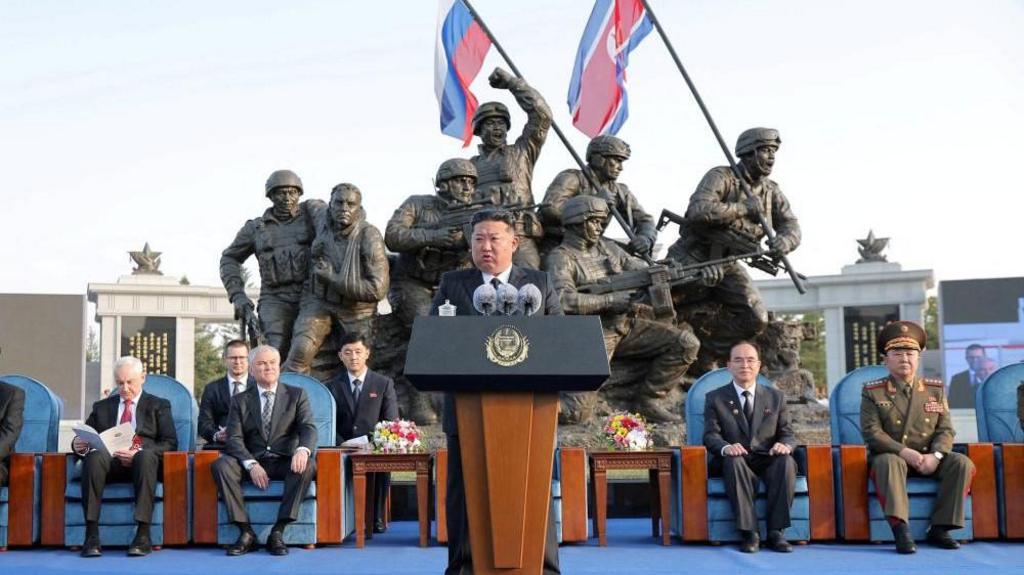
Kim Jong Un delivered a speech in Pyongyang on April 28 praising North Korean soldiers fighting in Russia's Kursk region who detonated their own grenades rather than be captured by Ukrainian forces. Calling them 'heroes,' Kim said those who 'unhesitatingly opted for self-blasting, suicide attack, in order to defend the great honour' embodied 'the definition of the height of loyalty.' South Korea estimates at least 15,000 North Korean soldiers have been sent to Russia, with over 6,000 killed. Russian Defence Minister Belousov attended the memorial ceremony where Kim spoke. One captured North Korean soldier, shown on South Korean broadcaster MBC, said: 'Everyone else blew themselves up. I failed.'
Kim is not just honoring the dead. He is encoding the self-destruction policy into public doctrine so that every future soldier knows the expected behavior, and every potential defector knows the official interpretation of surrender.
The Hidden Bet
North Korean soldiers are fighting because they were ordered to and had no choice.
The self-destruction policy only works as a deterrent if the alternative to suicide is worse than death. The fact that at least one soldier was captured and was on camera saying he 'failed' by surviving suggests the indoctrination is deep enough that some soldiers genuinely internalized the doctrine. That is a different kind of military instrument than a conscript force.
Russia views North Korean soldiers primarily as cannon fodder.
Russian Defence Minister Belousov attended Kim's memorial ceremony in Pyongyang personally. That is not how you treat cannon fodder. Russia is cementing a political alliance, not just consuming a military resource. The June 2024 mutual defense treaty is becoming operational, not theoretical.
The self-destruction policy reveals weakness in North Korean military doctrine.
It reveals a different kind of strength: the ability to send soldiers into a foreign war, sustain 40% casualties, and have the leader publicly honor the dead without any domestic accountability mechanism. No democracy could manage this. It is a feature, not a bug, of the North Korean system.
The Real Disagreement
The genuine tension is about what this deployment is actually for. One reading says North Korea sent troops to earn Russian support: technology transfers, energy, hard currency, and diplomatic protection. In this reading, Kim got what he needed and the soldiers are the price. The other reading says Kim sent troops to test and harden his military, to gain real combat experience against modern warfare with drones and precision munitions, knowledge his forces had no other way to acquire. These are not mutually exclusive, but they have different implications. If it is primarily about Russian support, Kim can scale back when the war winds down. If it is about military modernization, the deployment will continue or expand as long as there is something to learn. The 6,000 killed in a foreign conflict is an enormous number for a country of 26 million. Kim is describing it as glory. He would not do that unless he intended more of it.
What No One Is Saying
The Ukrainian prisoners' testimony is a data leak Pyongyang cannot control. North Korean soldiers are being captured, talking to cameras, and their testimony is broadcast. Kim's speech publicly honoring self-destruction is partly a response to that leak: a real-time attempt to brand captured soldiers as failures before their testimony spreads inside North Korea. The war in Ukraine is creating an information channel that did not exist before.
Who Pays
North Korean soldiers and their families
Ongoing for the duration of the deployment
Deaths are honored as loyalty, not acknowledged as loss. Families cannot publicly grieve, question, or refuse. The memorial ceremony is state theater, not consolation.
Ukraine
Immediate tactical cost on the front lines
North Korean soldiers fighting under a suicide-not-surrender doctrine are harder to capture for intelligence purposes and may be tactically more persistent than Russian conscripts who can more easily disengage. The doctrine makes them more useful to Russia as a military asset.
South Korea and Japan
Long-term, as returning veterans and doctrine updates reshape DPRK military posture
A North Korean military that has gained real combat experience in modern drone warfare, siege operations, and electronic warfare represents a meaningfully different threat than one that has only trained in simulation. The upgrade in North Korean military capability is the strategic cost that will be paid over years.
Scenarios
Deployment continues through 2026
North Korea sends additional troops as Russia rebuilds losses. Kim consolidates the Russia alliance as a counterweight to US-South Korea-Japan cooperation. The casualties continue but are publicly framed as heroism.
Signal Any further North Korean troop movements toward Russia's borders or KCNA reporting new 'volunteer' units.
Withdrawal on Russian terms
A ceasefire or peace deal in Ukraine allows Russia to withdraw North Korean troops with face-saving framing. Kim declares victory, claims the deployment achieved its objectives, and focuses on domestically exploiting the military knowledge gained.
Signal Any joint Russian-North Korean statement using language of 'mission accomplished' without referencing specific outcomes.
Prisoner testimony becomes a domestic crisis
More North Korean soldiers are captured on camera. Their accounts of the war, Russian treatment, and conditions contradict the heroism narrative. The information begins penetrating North Korea via smuggled media. Kim responds with a purge or a domestic crackdown.
Signal A sudden increase in North Korean state media attacks on 'foreign disinformation' about the deployment.
What Would Change This
If captured North Korean soldiers publicly described being deceived about where they were going or what they were fighting for, the voluntary framing of the deployment would collapse. Russia and North Korea are both motivated to prevent this, but Ukraine has every incentive to ensure it happens.
Related
The Memorial That Normalizes a New Alliance
power184 Sanctioned Russian Ships Passed Through UK Waters. None Were Boarded.
conflictEurope Just Had Its Biggest Military Spending Surge Since 1953. It Is Not Enough and Everyone Knows It.
powerThe EU's 20th Sanctions Package Still Pays Russia to Run a Nuclear Power Plant in Ukraine