Russia Lost Ground in April. Ukraine Is Striking Oil Refineries 1,600 Kilometers Deep.
What happened
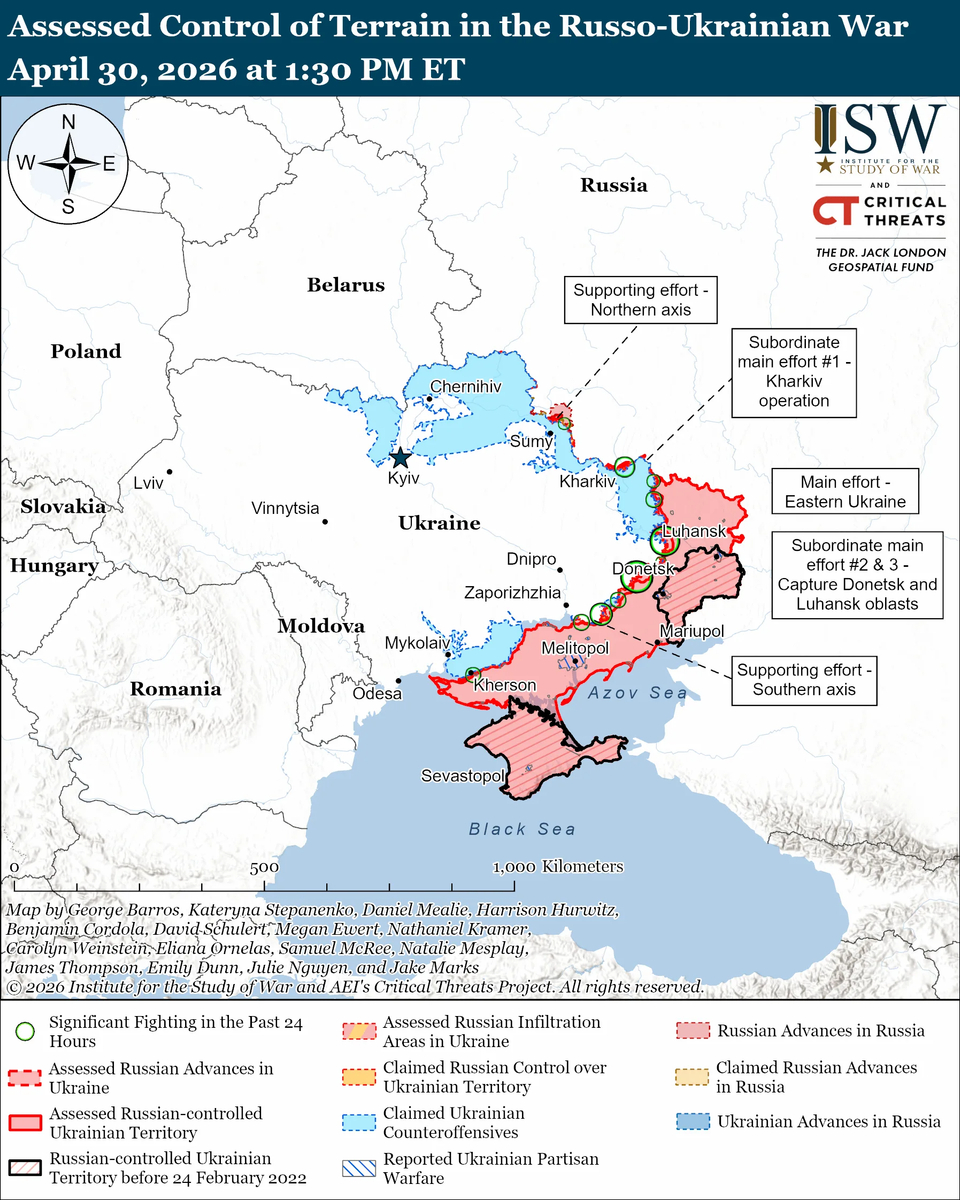
Russia suffered a net loss of 116 square kilometers of Ukrainian territory in April 2026, according to ISW assessment. This is the first net monthly territorial loss for Russia since Ukraine's August 2024 Kursk incursion. Ukraine has simultaneously escalated deep strikes: drones hit Russian oil infrastructure in Krasnodar, Perm, and Orenburg, struck the Tuapse Oil Refinery four times in April, and confirmed strikes on Russian aircraft as far as 1,676 kilometers from the international border, the deepest confirmed strike distance of the war. Russian refinery output has reportedly fallen to its lowest point since December 2009. Ukrainian forces also struck two Russian oil tankers near Novorossiysk on Saturday.
Ukraine is not winning the land war, but it is winning the infrastructure war, and those are different conflicts with different timelines. The question is whether the refinery campaign degrades Russia's military economy faster than the ground war degrades Ukraine's.
Prediction Markets
Prices as of 2026-05-03 — the analysis was written against these odds
The Hidden Bet
April's net territorial reversal signals a sustained shift in the war's trajectory.
ISW explicitly warns that May and June historically see Russian advances increase as the rasputitsa mud season ends and ground dries. The April improvement may be seasonal, not structural. Russia increased assault actions by 2.2% even as its gains fell, suggesting it is absorbing losses rather than running out of capacity.
Ukraine's deep-strike campaign against oil infrastructure is changing Russian war-making capacity.
Russia can import refined products from China and redirect domestic refining capacity. Degrading refineries slows production but Russia has proven resilient to prior economic shocks. The campaign may impose costs without crossing the threshold required to alter battlefield outcomes in the 6-month horizon.
A ceasefire is near. The improved Ukrainian position creates a window for negotiations.
Polymarket prices a Ukraine-Russia ceasefire by end of 2026 at only 25.5%. By May 31, the market says 6%. Russian Security Council Deputy Medvedev explicitly said Russia is in an 'existential conflict with the West' after Trump's April 29 call with Putin. Putin's public posture and the ceasefire market together suggest this is not a negotiation window.
The Real Disagreement
The genuine fork is whether to read the April data as evidence that Ukraine's combination of deep strikes, counterattacks, and Starlink disruption of Russian communications is creating a slow-motion Russian operational collapse, or whether to read it as a seasonal fluctuation that will reverse in May when ground hardens. The ISW believes it is structural: the February Starlink block and Telegram throttling 'exacerbated existing problems' within the Russian military. DeepState's metric that Russia needs 36 assault actions to gain one square kilometer of territory is striking. That ratio, if it holds, means Russia is burning through assault capacity at a rate that cannot be sustained indefinitely. The lean here is toward the structural reading, but with significant uncertainty. May and June will be the test.
What No One Is Saying
The Iran war is doing what Western sanctions and Ukraine's ground resistance alone could not: consuming Russian military resources, attention, and diplomatic capital simultaneously. Russia is watching Iran, its strategic partner, absorb American and Israeli strikes while also fighting Ukraine, facing European rearmament, and trying to sustain its own offensive. The coordination of these pressures on the Russian state is not accidental, but no Western government will say so publicly because saying it implies the Iran war was strategically valuable for Ukraine, which is politically unusable for everyone involved.
Who Pays
Civilians in Donetsk, Kharkiv, and Zaporizhia
Ongoing, every night.
Russia launched 206 drones toward Ukraine in a single night (May 2) and 409 in another. Even as ground advances slow, the air campaign against civilian infrastructure continues. The asymmetry is that Ukraine's deep strikes hit military-industrial targets while Russian strikes hit power plants and residential areas.
Russian energy sector and state budget
Compounding over weeks and months.
Refinery output at its lowest since 2009. Export tankers struck. Revenue from oil exports, Russia's primary war funding mechanism, is under active military attack. The compound effect of low oil prices, infrastructure damage, and reduced output is significant but currently not decisive.
European governments counting on a ceasefire to relieve defense spending pressure
Medium-term, 6-18 months.
If the war continues through 2026 with no ceasefire, the EU's promised 'prosperity plan' for Ukraine becomes indefinite aid under fire rather than a reconstruction program. The political cost of sustained defense spending in European democracies rises with every year the war continues.
Scenarios
Summer Reversal
Ground dries in May, Russia reconstitutes assault forces, and territorial gains in June and July erase April's reversal. Ukraine's deep strike campaign slows as Russia improves air defense coverage of refinery complexes. The war returns to the 2025 pattern of slow Russian advance.
Signal ISW May assessment shows Russian advances back above 100 sq km; Tuapse refinery repairs complete.
Structural Collapse
Russia's assault capacity degrades below the 36-actions-per-km threshold as supply chain effects from refinery strikes compound. Russian advances in May stay below 50 sq km despite dry conditions. Western governments quietly begin ceasefire talks at Russia's request, not Ukraine's.
Signal ISW June assessment confirms second consecutive month of Russian net territorial loss; Russian Ministry of Defense stops publishing advance metrics.
Escalation by Russia
Putin interprets US troop withdrawal from Germany as reduced Western commitment and orders a surge campaign in summer, accepting higher Russian casualties to break Ukrainian lines before European rearmament delivers capability. The war intensifies.
Signal Russian operational tempo above 200 assault actions per day sustained for three weeks; new Russian forces committed from formations held in reserve.
What Would Change This
If ISW's May 2026 assessment shows Russian advances back above 150 square kilometers and the deep-strike campaign has not materially degraded Russian assault supply, the structural reading is wrong and the seasonal reading was correct. That would make the April reversal a weather event, not a war-turning development.
Related
Russia's Victory Day Ceasefire Is Already Over
conflictRussia Lost Ground in Ukraine for the First Time Since 2024. Ukraine Raised Its Nuclear Preparedness.
conflictThree Days of Quiet, Then Drones on Kyiv
conflictBoth Sides Declared a Ceasefire. Both Sides Violated It. Now They're Doing It Again.