Macron Is Offering Poland a Nuclear Umbrella. France Still Controls the Button.
What happened
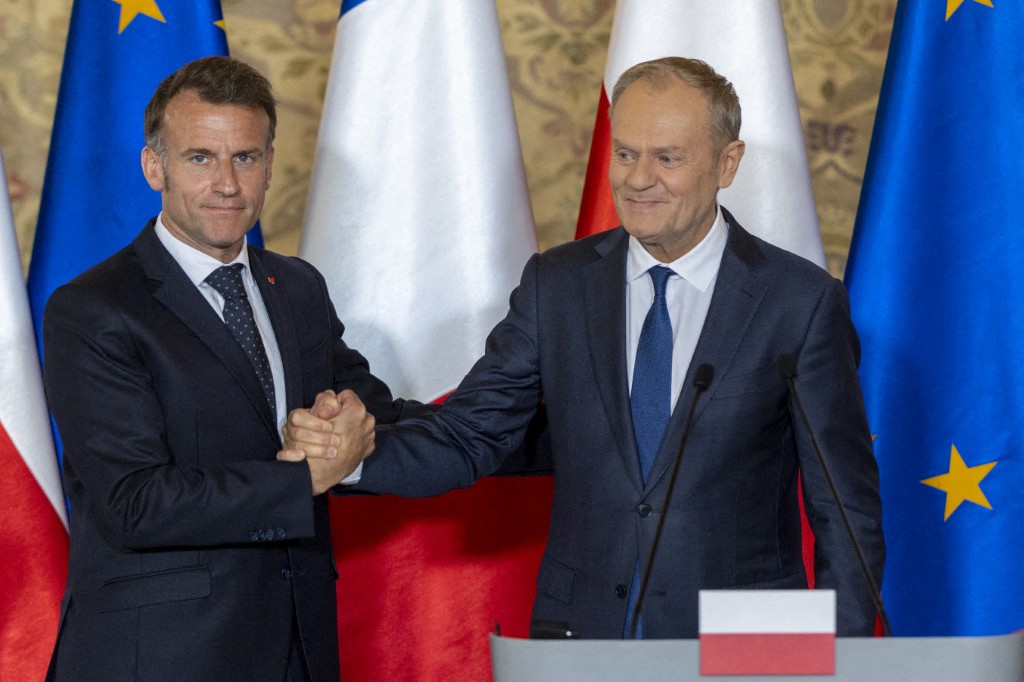
French President Emmanuel Macron and Polish Prime Minister Donald Tusk met in Gdansk on April 20-21 at the first Franco-Polish bilateral summit under the 2025 Treaty of Nancy. The two leaders announced plans for joint nuclear exercises under a forward deterrence framework that Macron has been developing since early 2026. Poland is now confirmed as part of a seven-country group, alongside Germany, Greece, the Netherlands, Belgium, Denmark, and Sweden, participating in French nuclear deterrence cooperation. The possible deployment of French nuclear-capable aircraft to Polish territory was discussed explicitly. A military satellite contract between Airbus, Thales, and Poland's Radmor was also signed. Russia's Kremlin spokesperson called the announcement evidence of European militarization and nuclearization.
France is offering a nuclear guarantee it does not need to consult anyone else to activate, and Poland is accepting because the alternative is depending on a US president who has called NATO allies cowards. The offer is real but the price is permanent French leverage over Polish security calculations.
Prediction Markets
Prices as of 2026-04-21 — the analysis was written against these odds
The Hidden Bet
A French nuclear umbrella can substitute for the US nuclear guarantee
France has roughly 290 nuclear warheads versus the US arsenal of 5,500. French doctrine has never included a first-use commitment for ally defense. Macron's framing is explicitly about deterrence, not a mutual defense pledge equivalent to Article 5. What Poland gains is a credible signal, not a treaty obligation backed by strategic parity.
This arrangement is primarily about deterring Russia
The deal also permanently restructures European power inside NATO. France becomes the continent's senior nuclear power with formal relationships across seven countries. Germany, which is part of the group, is explicitly excluded from the nuclear trigger. Macron is building a continental security order in which France is irreplaceable, which is a French strategic interest independent of Russia's behavior.
Trump's wavering on NATO is a temporary condition that will self-correct
Every European government that acts on this assumption is taking a structural bet that the US electorate, in 2028 and beyond, will return to the postwar consensus. If that bet is wrong, the Franco-Polish arrangement is not a bridge but the actual architecture. By building it now, Europe may be committing to a future it has not fully priced in terms of defense spending, command structure, and political authority.
The Real Disagreement
The actual fork is whether European strategic autonomy in nuclear matters is a dangerous escalation or a necessary hedge. The Kremlin says it is escalation; it probably is, in the narrow sense that extending deterrence eastward changes Russia's risk calculus. The European view is that a credible deterrent in Poland is less destabilizing than an ambiguous one, because ambiguity is what Russia exploits. The more honest tension is internal to Europe: France offering the umbrella retains unilateral control of the trigger. Poland is trading dependency on Washington for dependency on Paris. That is a better deal only if you trust Macron more than you trust the next US president, which is a bet Eastern Europe has not historically been comfortable making. The argument for the deal is pragmatic. The argument against it is that sovereign control of your security decisions has been quietly transferred from one distant capital to another.
What No One Is Saying
Poland is the largest conventional military in Europe east of Germany and is spending 4% of GDP on defense. France has nuclear weapons it has never used in a defensive capacity for an ally. The actual deterrent contribution in a conflict scenario would come overwhelmingly from Polish and NATO conventional forces, not from French nuclear posturing. The deal gives Macron more status than it gives Poland more security.
Who Pays
Poland's strategic autonomy
The dependency is built into the architecture; it activates in any future crisis
By accepting French nuclear deterrence cooperation, Poland becomes structurally dependent on French political decisions in any crisis that approaches nuclear thresholds. France retains sole authority over the trigger. Poland's veto on French nuclear use is zero.
Russia's near-abroad calculation
Structural shift; plays out over months to years depending on Russian threat level
The credible extension of a nuclear deterrence framework to Poland's eastern flank raises the perceived cost of conventional aggression against a NATO member. This is the intended effect, but it also tightens the Russian escalation ladder.
US leverage inside NATO
Slow-burn; accelerates if another country joins the French deterrence framework
Every bilateral nuclear arrangement between European states that does not require US authorization reduces the influence the US has over European security decisions. Trump may welcome this as burden-sharing; it is also the permanent diminution of US veto power over European military action.
Scenarios
Architecture Hardens
Germany formalizes its participation, the seven-country group publishes a joint deterrence doctrine, and French nuclear-capable aircraft are deployed to Polish air bases by year-end. The US-led NATO structure becomes dual-track.
Signal Germany's parliament approves participation in French nuclear exercises before the Bundestag summer recess
Symbolic Posture Only
Actual deployment of French aircraft to Poland does not materialize before the 2027 French presidential election. The framework exists on paper but carries no operational weight. Russia continues to read the ambiguity as manageable.
Signal No French aircraft are forward-deployed to Poland by Q4 2026; the 'concrete progress' Macron promised remains undefined through summer
US Pushback Forces Retreat
A new US Secretary of State or Secretary of Defense explicitly frames the Franco-Polish arrangement as undermining NATO command unity. The Trump administration conditions continued US Article 5 commitment on Europe not developing parallel nuclear arrangements. France and Poland walk back the most explicit elements of the deal.
Signal Pentagon or State Department issues a formal statement characterizing the Franco-Polish nuclear framework as complicating NATO nuclear planning
What Would Change This
If Macron publicly defines the specific conditions under which France would use nuclear weapons in defense of a NATO ally, the bottom line changes substantially: that would be a real deterrent, not a strategic posture. As long as Macron retains sole discretion and no published trigger conditions exist, this is leverage, not a guarantee.
Related
France Is Offering Poland a Nuclear Umbrella the US Won't Confirm It Still Holds
powerAfter the Ceasefire, Trump Told NATO to Stay Away. The UK and France Launched Their Own Mission.
powerFrance Spends $53 Billion to Replace the American Guarantee
conflictTrump Pulls 5,000 Troops from Germany. NATO's Eastern Flank Is Now Improvising.