China's AI Chips Achieved Day Zero Parity with Nvidia. Jensen Huang Says His China Share Is Now Zero.
What happened
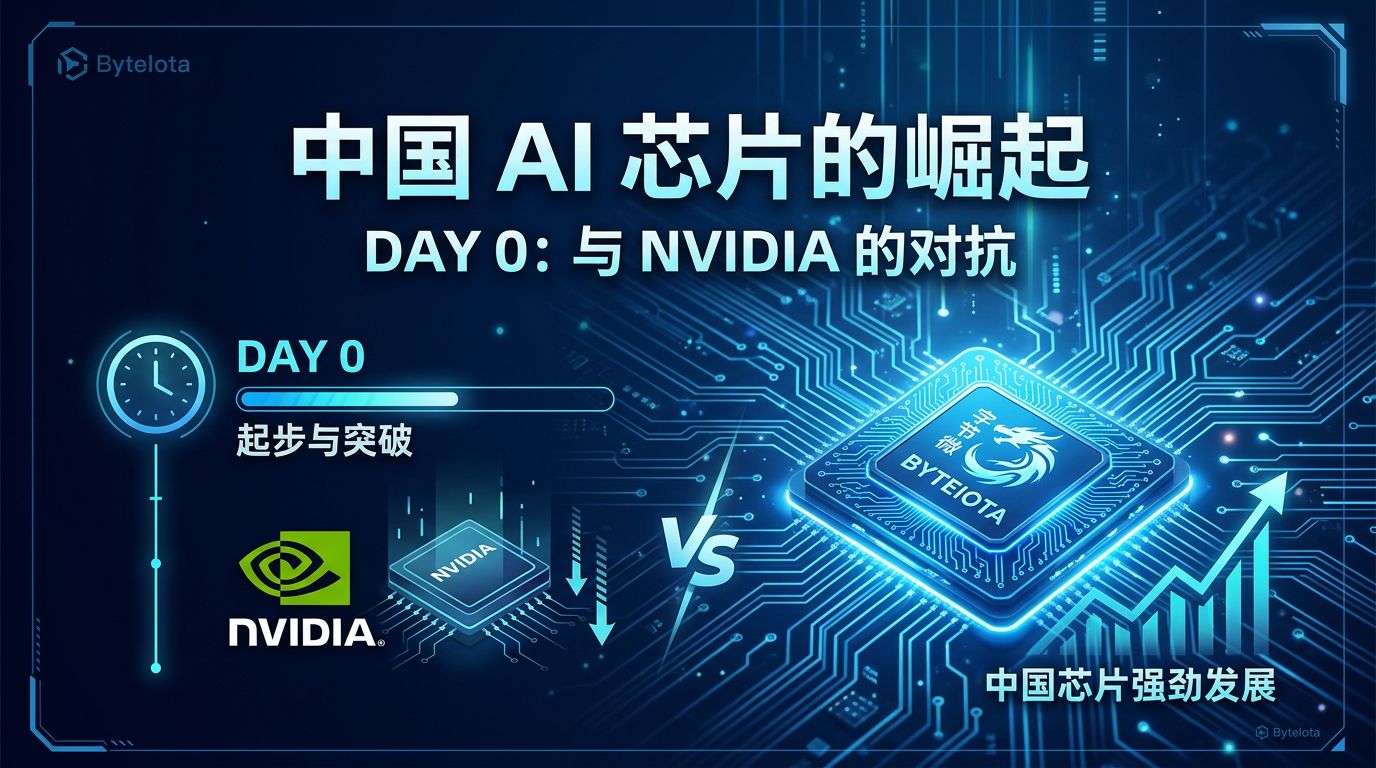
DeepSeek released its V4 model on April 29, and Chinese chip companies including Huawei Ascend, Cambricon, and Moore Threads all achieved Day 0 adaptation, meaning the model ran on domestic chips the same day it launched. This timing capability was previously exclusive to Nvidia. Nvidia CEO Jensen Huang acknowledged in the most recent earnings season that the company's share of China's AI accelerator market has fallen to zero, down from a near-monopoly of 95% before 2020. Huawei's Ascend 950PR now delivers 2.8 times the performance of the H20, the only Nvidia chip permitted under current export control rules.
The US chip export controls succeeded in removing Nvidia from China; they failed to stop China from building a replacement. The two outcomes are not in tension. They were always the likely result.
Prediction Markets
Prices as of 2026-05-11 — the analysis was written against these odds
The Hidden Bet
Export controls slow Chinese AI development by denying frontier chips
Denial of Nvidia chips forced Chinese chipmakers to build alternatives. DeepSeek V4 running on Huawei Day 0 means the software-hardware co-evolution gap has closed for inference workloads. The controls may have accelerated China's domestic chip industry rather than arrested it.
Nvidia's CUDA ecosystem lock-in is durable
CUDA advantage derives from developer habit and ecosystem depth. Cambricon open-sourced their DeepSeek V4 adaptation code. If the Chinese developer community standardizes on Huawei and Cambricon frameworks within China, CUDA lock-in has no purchase there. The question is whether open-source AI models accelerate this globally.
DeepSeek V4 is competitive with Western frontier models
Chinese industry media noted V4 still trails Claude Opus 4.6 in agent benchmarks, the workload that matters most for enterprise software. Benchmark parity on narrow tests does not equal product parity. Huang may be correct that DeepSeek V4 first deploying on Huawei chips is the real story, not V4 itself.
The Real Disagreement
The genuine fork is whether US export controls are working. The administration argues the controls forced China to build inferior alternatives on degraded hardware, buying time. The counter-case, now supported by Huang's own earnings disclosure, is that the controls removed Nvidia from China entirely while Chinese companies used the forced independence to build an ecosystem that no longer needs Nvidia. Both cannot be right. The administration is treating Nvidia's revenue loss as a strategic victory. The market treats Nvidia's China share as already zero and is pricing Nvidia's future on whether it can hold the rest of the world. The second framing is more accurate. The controls did not delay Chinese AI. They decoupled it.
What No One Is Saying
Nvidia is lobbying against the export controls not purely for revenue reasons. Jensen Huang's deeper argument is that if Chinese developers standardize on Huawei's software ecosystem inside China, and DeepSeek V4 propagates globally as open-source, then the CUDA ecosystem could face a global split. China could become the reference platform for open-weight AI deployment in the Global South. That would be a far more durable loss than revenue.
Who Pays
US AI chip supply chain outside China
18 to 36 months as Chinese chip performance and software maturity improves
Chinese chip independence means the global AI market bifurcates. Companies building on open-source DeepSeek models may choose Huawei or Cambricon infrastructure if it is cheaper, even outside China. Nvidia's total addressable market shrinks.
US policymakers defending the export control rationale
Already happening; the earnings disclosure is public
If Nvidia's China share is zero and China's AI development has not visibly slowed, the strategic justification for the controls requires revision. The controls will be defended anyway because reversal is politically impossible, meaning the actual policy cost remains unexamined.
Global South AI developers
Starting now, accelerating through 2027
They now have a choice: Nvidia's closed ecosystem at premium prices, or open-source models running on cheaper Chinese-backed hardware. That choice did not exist before 2025. It is not obvious which direction they choose.
Scenarios
CUDA Split
Open-source DeepSeek models become the dominant choice for inference in cost-sensitive markets. Huawei and Cambricon become the default hardware platform in China and increasingly in Southeast Asia and Africa. Nvidia retains dominance in Western hyperscaler training.
Signal Huawei Ascend ships begin appearing in Indian, Indonesian, or Middle Eastern AI infrastructure procurements at scale.
Quality Ceiling Holds
Chinese chips remain performance-competitive for inference but fall short in frontier training. The next generation of frontier models requires hardware capabilities Chinese chips cannot yet match. DeepSeek V5 is delayed. The quality gap reasserts itself.
Signal DeepSeek's next model requires Huawei clusters for training but Huawei announces delays to its 950PR mass production timeline.
US Escalation
Washington expands export controls to ASML and Dutch lithography equipment, or imposes secondary sanctions on Huawei chip customers. This would slow future generations of Chinese chips but not affect chips already deployed.
Signal A new BIS rule or congressional legislation targeting ASML EUV sales to third countries.
What Would Change This
Evidence that Chinese chips fail on the next generation of frontier training runs, not inference. If DeepSeek V5 requires hardware China cannot domestically produce, the export control argument recovers. The Day 0 inference story does not prove the training story.