Trump Flies to Beijing. China Says Taiwan Is the Price of Admission.
What happened
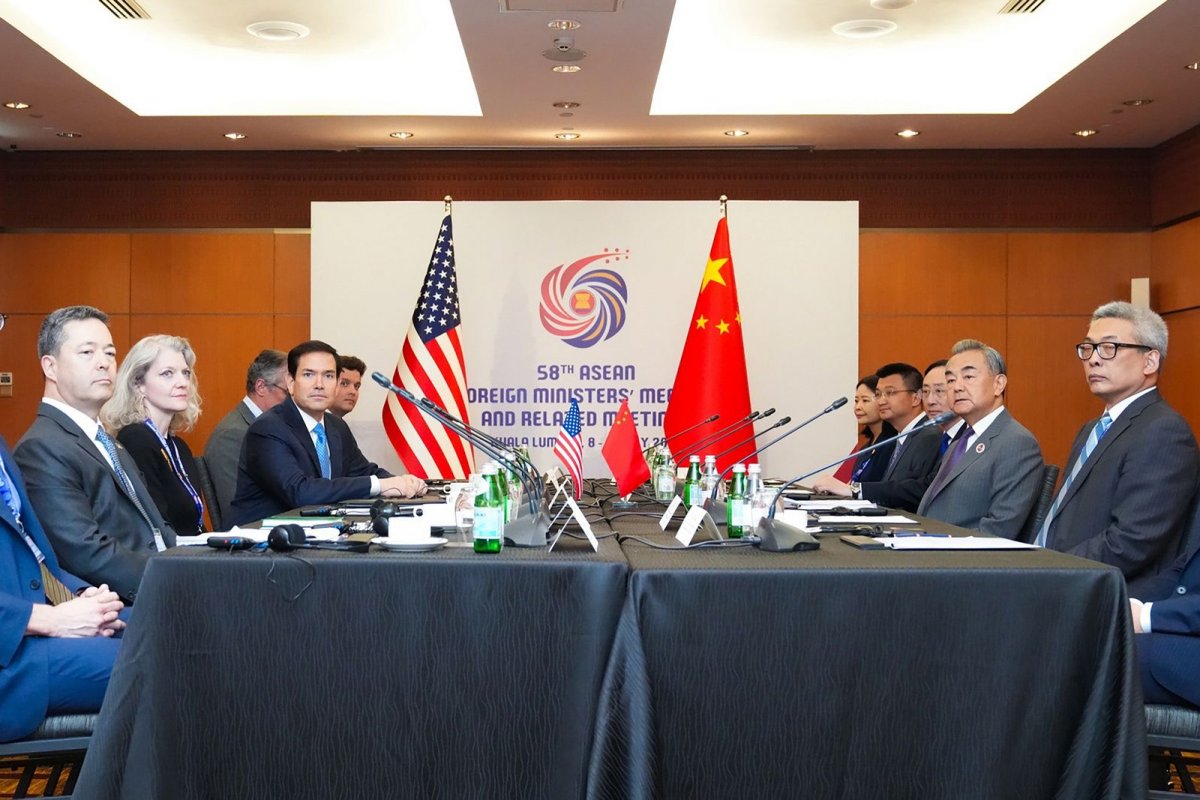
Senior US and Chinese diplomatic and economic officials held a series of calls on April 30 and May 1, ahead of a planned Trump-Xi summit in Beijing on May 14-15. Chinese Foreign Minister Wang Yi told Secretary of State Rubio that Taiwan 'constitutes the biggest risk' in the US-China relationship and that the US 'should honor its commitments' on Taiwan. The US did not publish a public response contradicting this framing. Separately, Treasury Secretary Bessent and Chinese Vice Premier He Lifeng held 'candid and comprehensive' economic talks, with Bessent raising concerns about China's new extraterritorial regulations that require foreign companies to seek government approval before exiting China. The summit is proceeding despite ongoing tensions, with Polymarket showing an 86.5% probability Trump visits China by May 15.
The summit is happening, and China has been explicit about its price: a US commitment on Taiwan that it is calling 'honoring existing commitments' but that Taiwan's government is worried means new concessions.
Prediction Markets
Prices as of 2026-05-03 — the analysis was written against these odds
The Hidden Bet
The Trump-Xi summit is primarily a trade negotiation.
Wang Yi's opening framing was Taiwan, not tariffs. The Chinese side has structured the diplomatic pre-work to establish Taiwan as the foundational issue, with trade as the variable. If Trump goes to Beijing and agrees to 'honor commitments' on Taiwan in exchange for trade concessions, the US may have made a security commitment without acknowledging it publicly.
Trump's economic leverage — tariffs, technology restrictions — constrains China's ability to demand major concessions on Taiwan.
The US is simultaneously in a shooting war that has disrupted global energy supplies, facing domestic political pressure from an unpopular Iran conflict, and struggling economically. China is watching the US's political bandwidth and may calculate this is the moment to press for Taiwan commitments that would be unachievable under less stressed conditions.
Any Taiwan commitment made at the summit would need Congressional ratification and would face domestic political resistance.
Executive agreements — particularly implicit ones where the US simply stops doing something rather than formally committing to a new obligation — do not require Congressional approval. A Trump statement that 'the Taiwan issue is a matter for the Chinese people to resolve' would be a massive substantive concession without a single Senate vote.
The Real Disagreement
The real fork is between two interpretations of what 'honoring commitments' means. China's interpretation is that prior US statements — the one-China policy, the three communiques — commit the US to opposing Taiwan independence and reducing arms sales over time. The US interpretation has been that these statements do not preclude robust defense support for Taiwan. The summit's value to China depends on closing this gap. The summit's value to Trump depends on a trade deal and some kind of normalization signal that he can sell domestically. These goals are not obviously compatible. I'd lean toward the summit producing a vague formulation that both sides interpret as a win — China claims a Taiwan concession, the US claims a trade concession — and the real consequences only become clear when the next Taiwan arms sale or military deployment test occurs.
What No One Is Saying
Taiwan's government is alarmed, and that alarm is rational. When Beijing publicly frames Taiwan as the 'biggest risk' and says the US should 'honor commitments' two weeks before a summit, and the US does not publicly push back, Taiwan has to assume the summitry is happening partly at its expense. Taiwan's foreign ministry statement was careful diplomatic language for a very loud warning.
Who Pays
Taiwan
Medium-term, over years of accumulated precedent
Any implicit or explicit US commitment to reduce arms sales, stop arms transfers, or limit military exercises would reduce Taiwan's defensive deterrent against Chinese military pressure. The risk is not invasion in the short term — it is incremental coercive pressure that becomes harder to resist if the US has made concessions.
US tech companies operating in China
Near-term, ongoing
China's new extraterritorial regulations requiring exit approval from the government give Beijing a direct lever over US corporate assets inside China. Bessent raised this explicitly. If the summit fails to address it, US companies face growing asset vulnerability.
US allies in the Indo-Pacific (Japan, South Korea, Philippines)
Ongoing, as precedent
Any reduction in the credibility of US Taiwan commitments affects the security calculus of every US treaty ally in the region. They observe what happens to Taiwan's security relationship under pressure and update their own assumptions about US reliability.
Scenarios
Package Deal
Trump and Xi agree to a trade framework that rolls back some tariffs in exchange for Chinese purchase commitments. On Taiwan, the joint statement uses language that China frames as a concession — something like 'the US reaffirms the one-China policy and opposes unilateral changes to the status quo by either side.' The US frames this as no change. Taiwan is alarmed but cannot publicly oppose it.
Signal Watch for the joint statement language on Taiwan to include any new qualifier or commitment beyond existing US one-China policy language. Even one new phrase is a concession.
Summit Collapses on Taiwan
The US refuses to make any Taiwan-related concessions that China can frame as new commitments. China responds by walking back trade concessions. The summit produces a thin joint statement. The relationship returns to managed tension.
Signal Watch for US Taiwan arms sales to be announced in the two weeks before the summit — that would signal the US is not willing to make the concession China is seeking.
Trade Deal, Taiwan Ambiguity
A significant trade agreement is announced with specific tariff reductions and Chinese purchase commitments. The Taiwan language in the joint statement is so deliberately vague that both sides can claim it. Taiwan protests. The US says nothing changed. China says it did.
Signal Watch for the joint statement to include a Taiwan section longer than two sentences but shorter than a formal commitment. Deliberate opacity on Taiwan with specificity on trade is the tell.
What Would Change This
If the US announced a major Taiwan arms sale in the 10 days before the summit and proceeded with the meeting anyway, that would suggest the Taiwan pressure is genuinely a formality and the summit is really about trade. If the summit is postponed again — it was nearly pushed back due to the Iran situation — that suggests the Taiwan terms are the sticking point, not just posturing.
Related
The Summit Without a Spine
powerUS and China Trade Barbs Two Weeks Before the Summit. Both Sides Are Building Leverage, Not Trust.
powerTrump Flies to Beijing Saying He Does Not Need Xi's Help -- Which Is How You Ask for Help
powerTrump Is Going to Beijing. China Is Already Pricing the Trip.