Volkswagen Says Its Future Is at Risk. It Is Now Considering Letting Chinese Rivals Build Cars in Its Own European Factories.
What happened
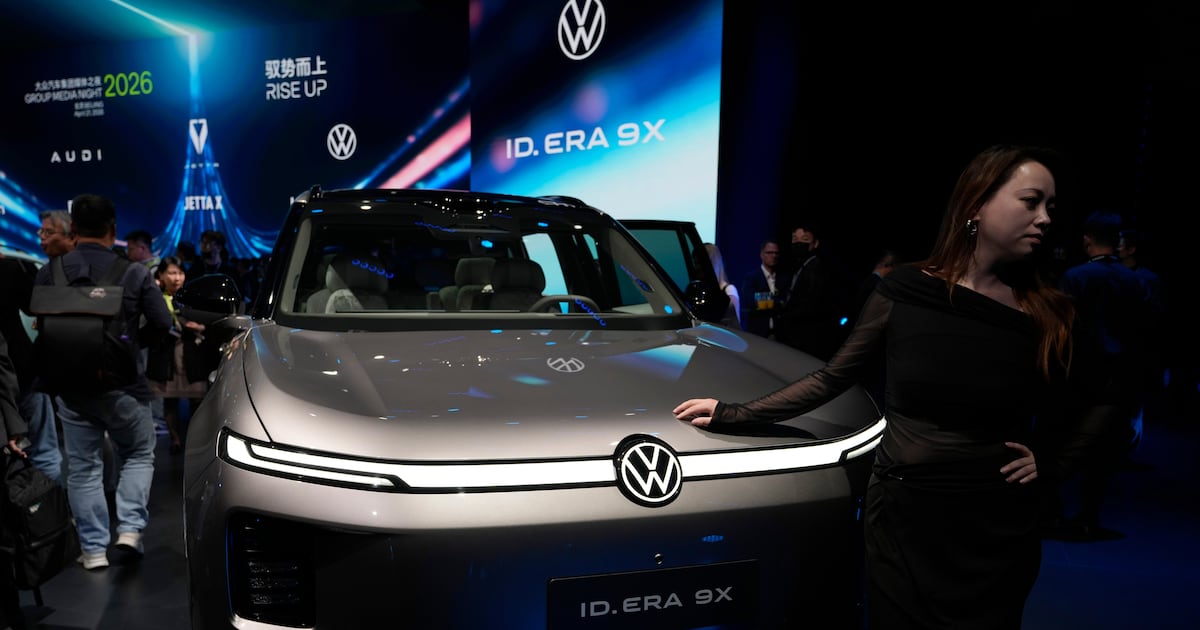
Volkswagen reported Q1 2026 operating profit of 2.5 billion euros, down 14.3% year-over-year and well below analyst expectations of nearly 4 billion euros. The company's CFO warned that planned cuts are not sufficient and that VW must 'fundamentally change its business model.' VW already has plans to cut 50,000 jobs across its brands in Germany by 2030. CEO Oliver Blume said the company is now considering sharing underutilized European factory capacity with Chinese automaking partners, including potentially BYD, as a cost reduction strategy. The company is simultaneously squeezed by US tariffs on its US sales, Chinese competition on its home turf, and weak EV demand across Europe.
Volkswagen, the company that built postwar German industrial identity, is considering handing floor space in its own European factories to the Chinese competitors that are killing it. That is not a cost-cutting strategy. That is a controlled collapse.
Prediction Markets
Prices as of 2026-05-01 — the analysis was written against these odds
The Hidden Bet
Sharing factories with Chinese partners is a rational cost optimization
The companies VW is considering inviting in, BYD and others, are not just competing with VW in China. They are gaining market share in Europe, where VW's survival depends. Every car a Chinese brand builds in a VW factory at low cost is a car sold to a European buyer who might otherwise have bought a VW. The short-term cash flow from factory utilization fees does not offset the long-term market share loss.
US tariffs are the primary cause of VW's crisis
VW's problems predate the current tariff regime. The company failed to execute on EV transition, bet on China as its growth market just as that market became contested, and carried bloated German labor costs while Chinese manufacturers operated at a fraction of the per-vehicle cost. Tariffs accelerated the crisis but did not create it. Removing tariffs would not restore VW's competitive position.
The EU's tariffs on Chinese EVs (up to 38%) protect European automakers
EU tariffs on Chinese EVs were imposed to protect European manufacturers from subsidized competition. But VW's response to this protection is to invite the same Chinese companies to build inside Europe, co-producing with them, which routes around the tariff entirely. The protectionist measure is being neutralized by the very company it was meant to protect.
The Real Disagreement
The genuine fork is whether VW should be saved as a European industrial champion or allowed to restructure toward whatever configuration is financially viable. Germany's government, unions, and political establishment treat VW as an institution that cannot be allowed to fail. The market says VW's cost structure is not competitive and will not become competitive through incremental cuts. Both positions have merit. The German social contract is partly built on the kind of high-wage industrial employment VW represents, and the loss of 50,000 jobs would be politically destabilizing. But propping up a company whose fundamental problem is a structural cost disadvantage that no amount of restructuring fully closes means spending enormous political and financial capital to delay the inevitable. The honest question, which no German politician will ask publicly, is what the German economy looks like without a viable domestic auto sector, and whether building toward that transition is better than fighting it.
What No One Is Saying
VW is inviting BYD to co-produce in its European factories partly because BYD has no interest in facing the EU's Chinese EV tariffs. Co-producing in a VW plant makes the car European-made and tariff-exempt. VW's proposal is not primarily a cost play; it is being used to help Chinese brands circumvent the EU trade barriers the EU imposed to protect VW.
Who Pays
German auto workers
2026 through 2030
The 50,000 job cut target in Germany is the floor, not the ceiling. If the fundamental business model change the CFO described requires production sharing with lower-cost Chinese partners, German plants become increasingly underutilized
German suppliers and regional economies
2027 through 2032, structural
Wolfsburg, Ingolstadt, and other German cities built their tax base and service economies around VW and its suppliers. Production sharing with Chinese partners shifts supplier relationships and hollows out regional supply chains
EU consumers who assumed Chinese EV tariffs meant protection
2027 onward if co-production deals are signed
If VW and Chinese brands co-produce in European factories, the price advantage of Chinese manufacturing enters the European market via a tariff-exempt route, while European consumers continue paying prices that reflect the assumed protection
Scenarios
Managed Decline
VW strikes co-production deals with one or two Chinese partners, stabilizes cash flow in the short term, continues German job cuts on schedule, and gradually becomes a holding company for Chinese-designed cars produced in European facilities. The VW brand survives on legacy equity and premium positioning while volume shifts to partner models.
Signal Watch for VW to announce a specific Chinese partner name and factory for co-production before Q3 2026 earnings.
German Government Intervenes
Berlin treats the VW crisis as a national emergency, provides state aid, subsidizes EV production, and blocks co-production with Chinese brands as a national security and industrial policy matter. VW restructures with German taxpayer support, keeps the German job base, and remains a purely European manufacturer.
Signal Watch for the German government to publicly oppose the Chinese co-production proposal or to announce industrial subsidy packages specifically for auto sector EV transition.
Accelerated Collapse
Co-production deals fail to materialize or are blocked by EU regulators concerned about technology transfer. VW's cost structure continues to worsen. The company announces a larger restructuring that includes partial sale or spin-off of one or more brands, and potentially a Chinese equity stake in VW itself.
Signal Watch for VW to miss its own Q2 or Q3 2026 profit guidance and announce an emergency strategy review, which would signal the incremental approach has failed.
What Would Change This
A US-EU trade deal that reduced auto tariffs would provide short-term relief. But the structural problem is cost, not tariffs. The signal that would genuinely change the analysis is VW launching a competitive mass-market EV that sells at scale. They have not done that yet.
Related
The Trump-Xi Summit Is About Iran. China Wants It That Way.
powerThe Shoulder Missile Gambit
powerTrump Threatened 50% Tariffs on Iran's Arms Suppliers. The Supreme Court Already Took Away His Authority to Do That.
powerTrump Threatened 50% Tariffs on Iran's Arms Suppliers. He Has No Law to Do It With.