The Distillation War: China Is Copying US AI Models at Scale and Washington Doesn't Know What to Do About It
What happened
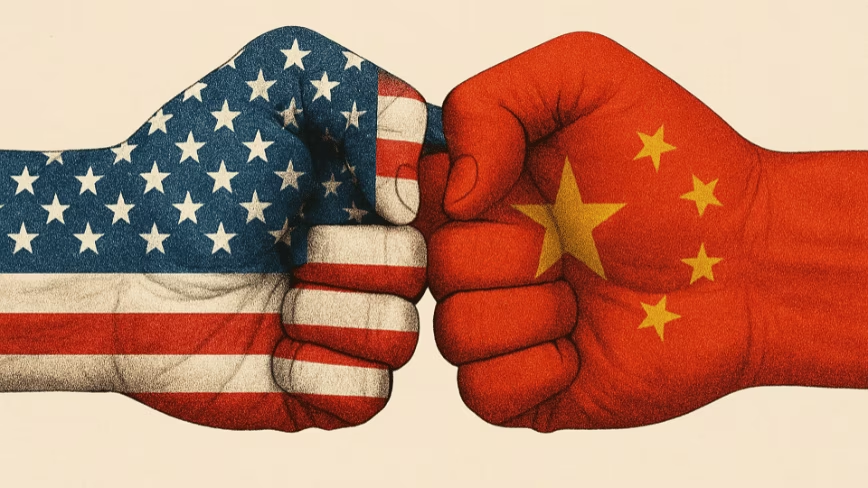
The White House Office of Science and Technology Policy circulated an internal memo last week accusing China of conducting deliberate, industrial-scale campaigns to extract capabilities from US frontier AI models through a technique called distillation, in which outputs from large models are used to train smaller competing ones. The State Department followed with a global cable alerting every diplomatic post to warn foreign governments about the risk. On April 27, the AI policy group Americans for Responsible Innovation called on OSTP to bar exports of advanced chips that could support this practice. Simultaneously, the House Foreign Affairs Committee advanced the MATCH Act, the largest package of export control legislation in congressional history, which would require the Netherlands and Japan to restrict DUV lithography machine sales to China within 150 days or face US enforcement.
Distillation is a software problem, and the US government is proposing hardware solutions. Blocking chip exports cannot prevent a company that already has capable GPUs from querying US AI APIs and training on the outputs.
The Hidden Bet
Export controls on chips will slow China's AI distillation capability
Distillation requires API access and compute, not frontier chips. DeepSeek's documented approach involved querying US model APIs, not running equivalent frontier training runs. The chips Congress wants to restrict are relevant to building frontier models from scratch, not to distillation.
The MATCH Act gives the US leverage over ASML's remaining China business
China warned that cutting off ASML servicing of existing machines would disrupt global semiconductor supply chains, not just Chinese ones. Dutch and Japanese governments have domestic economic interests in ASML revenues that may not align with a 150-day US ultimatum.
Labeling distillation as theft resolves the legal and policy question
Distillation using publicly accessible API outputs is legally contested. US AI companies have terms of service prohibiting training on outputs, but enforcement against Chinese companies is practically zero. The theft framing escalates politically but does not create an enforceable remedy.
The Real Disagreement
The real fork is whether to treat AI capability parity with China as primarily a hardware problem or a software problem. The hardware-first camp, currently dominant in Congress, wants to choke off chip supply so China cannot build models capable of distillation. The software-first camp argues the target should be API access restrictions and adversarial input detection. These are not complementary strategies. Prioritizing hardware controls signals to allies that US policy is about restricting supply chains. Prioritizing API controls signals that the problem is already inside the existing ecosystem. The hardware path is more politically legible but addresses the wrong bottleneck. The API path is technically correct but requires admitting that US companies' open API policies have been the primary attack surface.
What No One Is Saying
US AI companies charging for API access have a direct financial incentive not to implement the kind of adversarial query detection that would actually stop distillation. Every query they block is revenue they don't collect. The White House memo blames China, but the actual vector is US companies' own commercial decisions.
Who Pays
ASML and European semiconductor equipment suppliers
150-day deadline if MATCH Act passes; bill still in committee
The MATCH Act would require Dutch and Japanese governments to align with US restrictions or face enforcement. ASML's remaining China DUV business, which Beijing has already stockpiled heavily, would be cut off along with servicing revenue.
US AI labs and their investors
Medium-term, if policy pivots to API controls
If API access restrictions are eventually imposed to stop distillation, US companies lose revenue from the API queries that currently fund frontier model development. The cost of stopping distillation falls on the companies whose models are being distilled.
Global semiconductor manufacturers dependent on Chinese customers
Immediate upon any MATCH Act enforcement
The MATCH Act's 150-day ultimatum to the Netherlands and Japan could cause retaliatory action from China, which has already enacted laws targeting companies that discriminate against Chinese supply chains.
Scenarios
Hardware Tightening
MATCH Act passes. ASML phases out remaining China DUV sales and servicing. China accelerates domestic chip equipment development through SMIC and Huawei. US-China AI capability gap narrows on chips but distillation continues through existing infrastructure.
Signal The Netherlands announces alignment with US DUV export rules within 90 days of MATCH Act passage.
API Lockdown
OSTP issues guidance requiring US AI companies to implement adversarial query detection and block access from China-affiliated entities. Enforcement is spotty but visible. US AI companies report a meaningful revenue hit from lost API volume.
Signal OpenAI or Anthropic announces a China API access restriction policy within 60 days of the State Department global cable.
Escalation Spiral
MATCH Act advances. China retaliates with rare earth export restrictions targeting semiconductor-dependent US industries. The trade truce collapses before the Trump-Xi summit. Both sides announce parallel AI development mandates.
Signal China restricts rare earth exports for the second time in six months, this time targeting specific US defense supply chain inputs.
What Would Change This
If a US court or international arbitration body ruled that distillation using API outputs does not constitute IP theft under existing law, the entire legislative strategy built around the theft framing collapses. The administration would need a new legal theory or a new international treaty.
Related
China's AI Chips Achieved Day Zero Parity with Nvidia. Jensen Huang Says His China Share Is Now Zero.
powerThe US Just Sent Every Embassy in the World a Warning About DeepSeek. The Timing Is the Message.
powerThe White House Says China Is Copying America's AI. The Timing Is the Story.
powerDeepSeek Is Abandoning Nvidia. Jensen Huang Says That's Catastrophic. He's Right for the Wrong Reasons.