Who Is an American
What happened
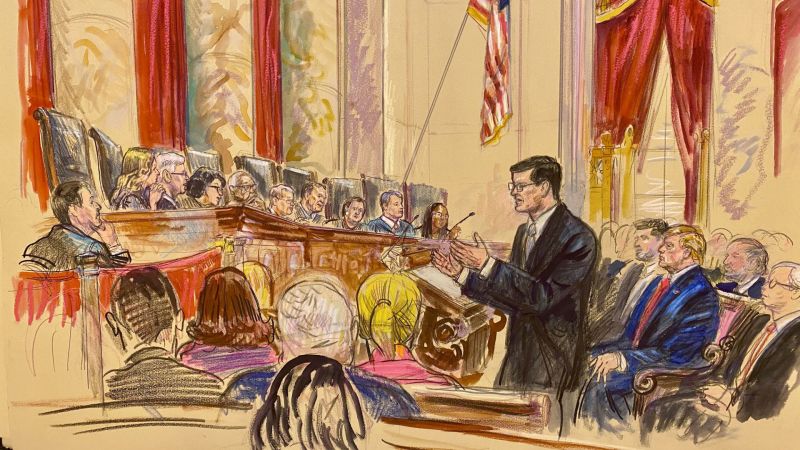
On April 1, the Supreme Court heard two hours of oral argument in Trump v. Barbara, a challenge to Trump's executive order ending birthright citizenship for children of undocumented immigrants and those on temporary visas. Courts have unanimously blocked the order from taking effect. The Trump administration's solicitor general, D. John Sauer, argued the 14th Amendment's citizenship clause does not guarantee citizenship to children of unauthorized immigrants. Multiple conservative justices, including those appointed by Trump, expressed skepticism. Justice Sotomayor pressed Sauer on whether the logic of his argument could be extended to retroactively strip citizenship from people already born. Trump attended the argument, left early, and called the proceeding a 'kangaroo court.' A ruling is expected by late June or early July.
The Court will almost certainly strike down the executive order. But the case has already done the work Trump needed it to do: it put retroactive stripping of citizenship on the table, made justices defend it on camera, and normalized a question that was not in public circulation before.
Prediction Markets
Prices as of 2026-04-13 — the analysis was written against these odds
The Hidden Bet
A ruling against Trump ends the birthright citizenship fight.
The executive order was always expected to lose in court. The administration has floated a legislative path and a constitutional amendment path. The judicial loss is not the strategy; it is the setup. A 9-0 ruling against Trump becomes campaign material framing the Court as obstructionist, not a defeat.
Birthright citizenship is constitutionally settled by Wong Kim Ark (1898).
Wong Kim Ark addressed a child born to legal permanent residents, not undocumented immigrants. The administration's argument that 'subject to the jurisdiction thereof' excludes people without legal status has never been squarely ruled on by the modern Court. Even justices who are skeptical of the executive order have not ruled out the possibility that the constitutional question is more open than widely assumed.
The risk is only to children born going forward.
Sotomayor explicitly surfaced the retroactivity problem during oral argument. If the constitutional theory is correct, it would apply to people already born. The administration said its order is only prospective, but Sotomayor's point was that no precedent would prevent a future president from applying the theory retroactively. That is not a hypothetical; it is a legal gap.
The Real Disagreement
The real split is not about the 14th Amendment text; it is about what courts do when the executive branch advances a legal theory that is wrong but not absurd. The liberal justices want the Court to shut it down hard and protect citizenship broadly. The conservative justices who are skeptical of the executive order still want to avoid setting precedents that constrain executive discretion too tightly on other immigration questions. The risk is a narrow ruling that strikes down this specific order but leaves the underlying constitutional theory unresolved, which preserves the question for another administration. A broad ruling affirming birthright citizenship unambiguously is better for clarity; a narrow ruling is better for institutional flexibility. The Court is more likely to choose narrowness.
What No One Is Saying
Trump attended the oral argument in person. A sitting president has not done that before. The message was not to the justices; it was to his base. He needed them to see him fighting the Court face to face, even in a case he was expected to lose. The politics of losing at the Supreme Court while standing in the building is more valuable than winning a case nobody was watching.
Who Pays
Children born to undocumented parents, if the order ever takes effect
Only if the Court rules for Trump, which the 95% Polymarket probability says is extremely unlikely
Statelessness: born in the US but not citizens of the US, not automatically citizens of any other country either, with no legal pathway to status.
Immigrants on temporary visas with US-born children
Same timeline as above; the legal exposure is theoretical now but would be immediate if the order takes effect
The executive order also covers children of people on legal temporary visas: H-1Bs, student visas, tourist visas. This is a much larger and politically different group than undocumented immigrants.
Courts and the rule of law
The delegitimization is ongoing; the ruling in June will test whether the Court's authority still carries weight
Trump calling the proceeding a 'kangaroo court' from inside the building, before the ruling, is an attack on judicial legitimacy designed to preemptively delegitimize an adverse outcome.
Scenarios
Narrow strike-down
The Court rules against the executive order 7-2 or 8-1, specifically on the executive authority question without resolving the constitutional reach of the 14th Amendment. The birthright citizenship question remains legally open.
Signal The majority opinion focuses on Congress's role in defining citizenship rather than reaffirming Wong Kim Ark categorically
Broad constitutional reaffirmation
The Court issues a 6-3 or 7-2 ruling that explicitly reaffirms birthright citizenship as constitutionally guaranteed for everyone born on US soil, closing the legal question for decades.
Signal The majority opinion cites Wong Kim Ark with approval and addresses the 'subject to the jurisdiction thereof' language directly
Legislative end-run
With the court case lost, the administration shifts to pushing Congress to legislate birthright citizenship restrictions, reframing it as a democratic rather than executive question.
Signal A House bill is introduced within 30 days of the court ruling; Trump posts about Congress needing to act
What Would Change This
If the Court's majority opinion leaves the constitutional interpretation of 'subject to the jurisdiction thereof' unresolved, the bottom line changes: this case is not a closure but an opening, and the next round will be legislative. If the Court reaffirms Wong Kim Ark categorically, the bottom line holds.
Related
SCOTUS Will Strike Down Trump's Birthright Citizenship Order. The Real Question Is What It Lets Happen First.
powerBirthright Citizenship: SCOTUS Will Almost Certainly Rule Against Trump, But the Ruling Will Do More Than That
powerThe Supreme Court Looks Poised to Rule Against Trump. His Own Party Is Already Moving Past It.
powerThe Supreme Court Is About to Rule on Birthright Citizenship. The Outcome May Turn on a Single Word from 1868.