After Orban
What happened
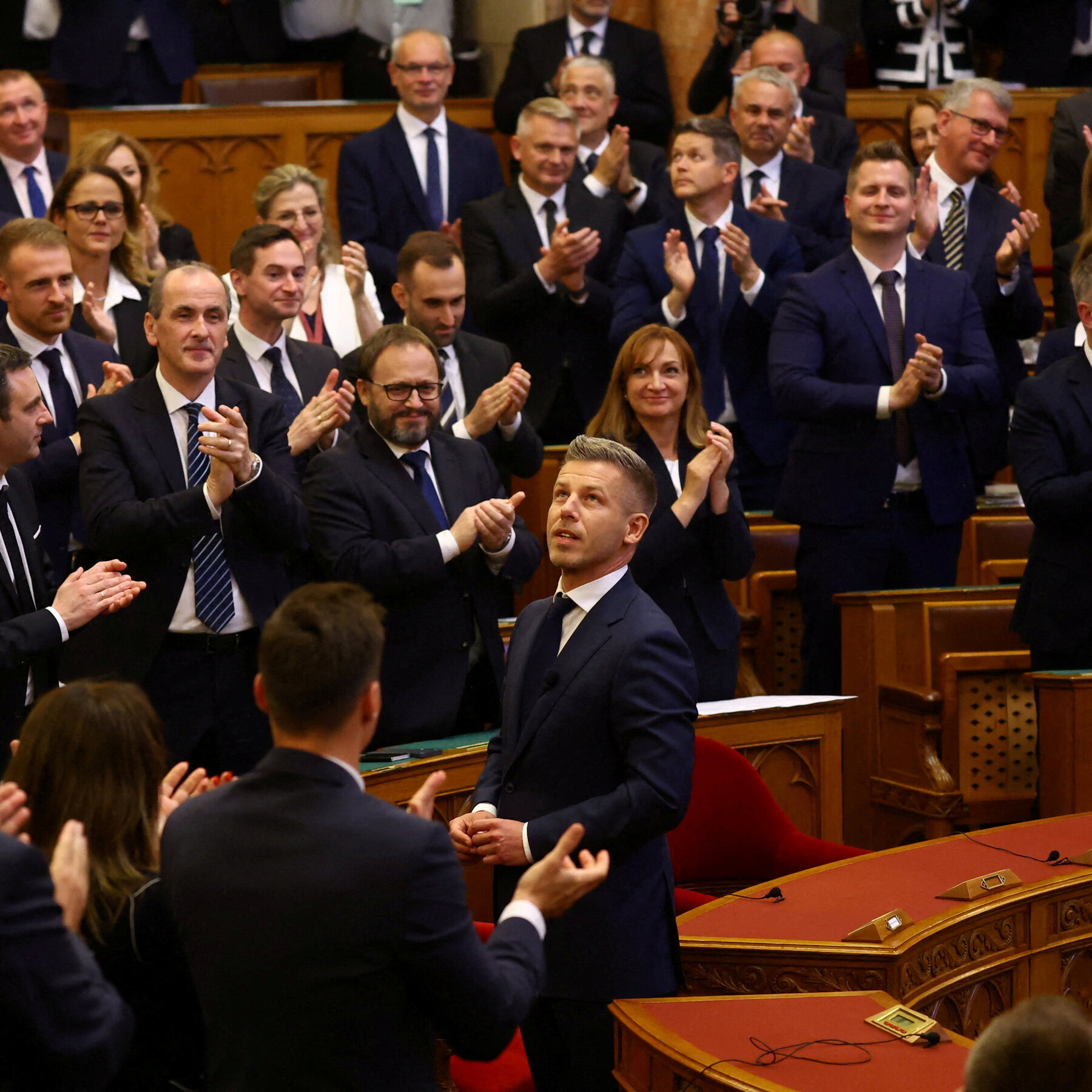
Peter Magyar, the former opposition leader who won a landslide election, has taken office as Hungary's new prime minister, receiving a standing ovation in parliament on Saturday. He faces the task of dismantling what Orban himself called an 'illiberal democracy': a political system in which key institutions (the courts, the civil service, major media, and state contracting networks) were redesigned over 15 years to entrench Fidesz control regardless of who held executive power. Fidesz loyalists are preemptively vacating positions before Magyar's promised housecleaning begins. Polymarket gives 69.5% odds that the Orban-aligned President Tamas Sulyok is pushed out by June 30.
Magyar won the election. Whether he can govern depends on whether laws and institutions respond to the person who holds the office or to the network that controls the underlying machinery.
Prediction Markets
Prices as of 2026-05-10 — the analysis was written against these odds
The Hidden Bet
Fidesz loyalists jumping ship signals institutional collapse that makes Magyar's job easier
Departing loyalists take institutional knowledge, informal networks, and in many cases documents that might support accountability. A disorganized retreat is not the same as a cleaned-up institution. Magyar will inherit offices where the people left but the informal power networks did not.
EU support will provide Magyar the leverage he needs to reform Hungary's courts and media
The EU can release frozen funds and restore democratic governance conditions. It cannot change the fact that Hungary's judiciary was packed with Orban-appointed judges under tenure protections. Legal reform requires either waiting for retirements, changing constitutional provisions (which requires a supermajority Magyar may not have), or passing legislation that will be immediately challenged in courts that Orban built.
Orban is finished as a political force
Orban remains within Hungary. His party retains significant parliamentary representation. If Magyar's government struggles to improve material conditions quickly (inflation, wages, housing), Fidesz becomes the opposition vehicle for discontent. Orban rebuilt after his 1994 defeat; he may attempt the same.
The Real Disagreement
The genuine tension is between speed and legitimacy. Magyar can move fast to dismantle Orban's network before it reconsolidates, but fast moves invite legal challenges, comparisons to Orban's own institutional aggression, and EU concern about rule-of-law compliance. Moving slowly preserves procedural legitimacy but gives the network time to adapt and dig in. This is not a false dilemma: both paths have real costs, and Magyar will have to choose.
What No One Is Saying
Orban's institutional durability in Hungary gave the European authoritarian right a proof of concept. If Magyar successfully unwinds the illiberal system through democratic means, it provides a counter-proof of concept that has implications far beyond Hungary. That is why this transition is watched closely in Warsaw, Bratislava, and Belgrade.
Who Pays
Hungarian civil society organizations and independent media
Ongoing; rebuilding is a decade-long project even under favorable conditions
They spent 15 years operating under surveillance, defunding, and legal harassment. A new government cannot instantly restore what was systematically dismantled. The rebuilding process takes years and requires resources that NGOs do not have after a decade of shrinkage.
Orban-connected oligarchs in Hungarian contracting
Beginning within 90 days as new government reviews major contracts
State contracting networks built around Fidesz-connected businesses will face investigation and potential reversal of contracts awarded without competitive bidding. The economic disruption to these actors is the point.
Scenarios
Partial reform, stable democracy
Magyar replaces key judicial and media leadership within his legal authority, EU funds flow, the economy improves modestly. Hungary becomes a functional electoral democracy again, though not a liberal one in the pre-Orban sense.
Signal EU rules Hungary compliant with rule-of-law conditions and releases the remaining frozen funds within 12 months.
Institutional gridlock
Orban-appointed judges block Magyar's most significant reforms. He cannot achieve the constitutional supermajority needed for deeper changes. Reform stalls. Fidesz regroups as effective opposition.
Signal A significant Magyar government initiative is struck down by the Constitutional Court within the first six months.
Orban's return scenario
Magyar's government fails to deliver visible economic improvement within two years. Orban runs again in 2030 on a 'look how bad it got without us' platform. History rhymes.
Signal Magyar's approval rating falls below 40% within 18 months while economic indicators remain stagnant.
What Would Change This
If Magyar can demonstrate concrete improvements in EU fund absorption and reduce corruption in state contracting in the first year, it establishes a different equilibrium where voters associate good governance with his party rather than with strongman politics. The window for that demonstration is approximately 18 months.