Trump Signed an Order Telling the Post Office How to Handle Ballots. The Post Office Answers to a Board That Answers to Nobody.
What happened
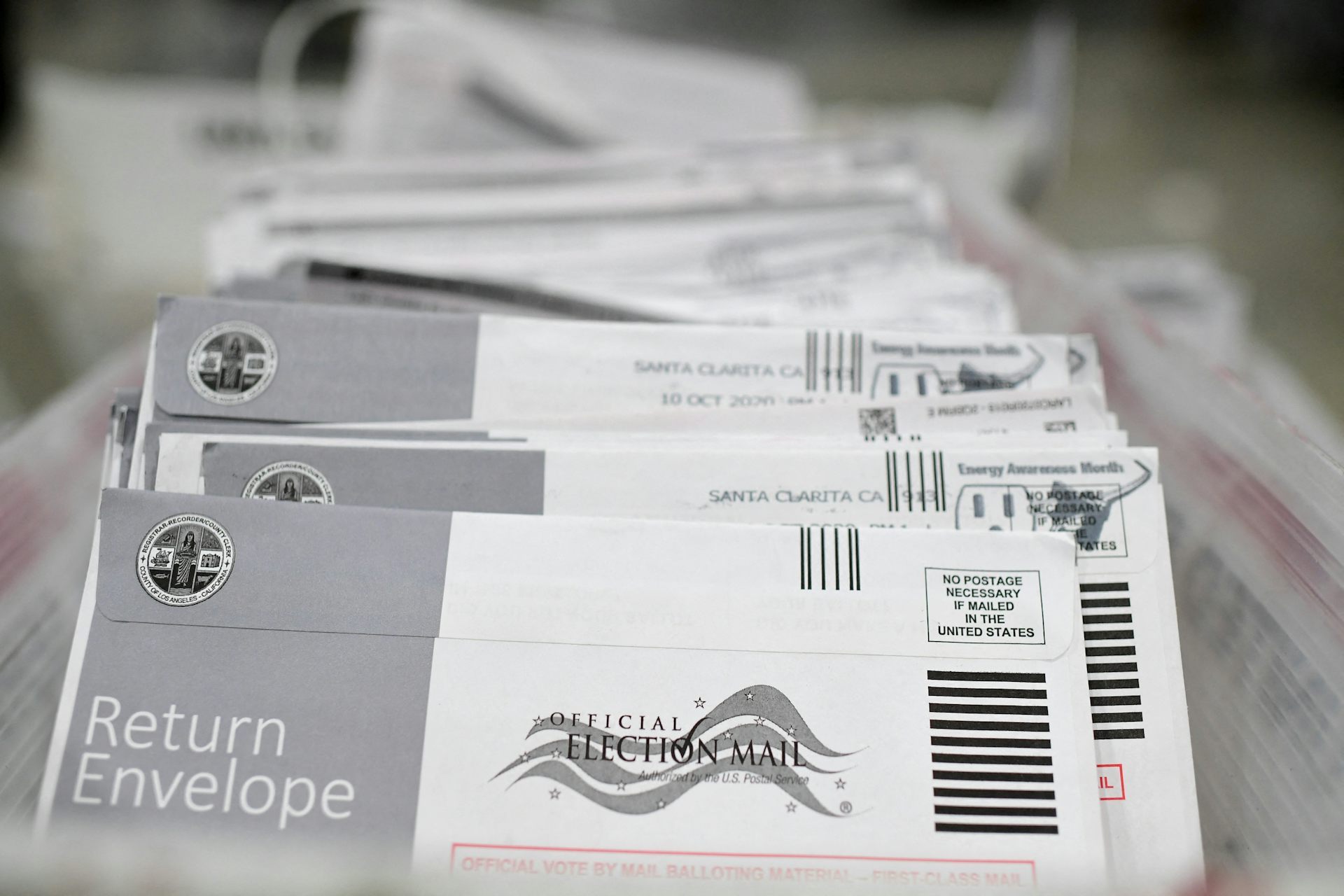
On March 31, 2026, President Trump signed an executive order requiring the postmaster general to set rules obligating states to notify the Postal Service before sending ballots by mail in federal elections. The order also creates new notification requirements around ballot deadlines. Postal experts and constitutional attorneys have described the order as an unconstitutional attempt to control state-administered elections through a nominally independent agency. Thirty-seven Democratic senators sent a formal letter urging the postmaster general not to comply. Missouri's attorney general is leading a Republican state coalition defending the order. As of April 25, a Polymarket market prices the probability the order is blocked this month at roughly 16 percent.
The order is either the beginning of executive control over how Americans vote, or a legally doomed performance designed to litigate federal election authority up to a SCOTUS that has already shown it will expand that authority.
Prediction Markets
Prices as of 2026-04-25 — the analysis was written against these odds
The Hidden Bet
The USPS board of governors will refuse a direct presidential order
The USPS board is composed of presidential appointees confirmed by the Senate. Under normal political conditions it functions independently. Under sustained presidential pressure, with a postmaster general who serves at the board's pleasure and the board serves at the administration's, the question of who gives orders is not as settled as the Postal Reorganization Act implies.
Courts will block this quickly the same way they blocked other Trump election orders
The current SCOTUS has expanded executive power significantly on immigration and administrative law. A narrow framing of the order, specifically as a notification requirement rather than a ballot restriction, could survive lower court challenge long enough to create real operational pressure on states with 2026 midterms approaching.
This is primarily about fraud prevention
The administration's own data on mail ballot fraud is thin. The order's operational effect is to create a notification system that maps which states send ballots and to whom. That is not a fraud prevention tool. It is a surveillance architecture for mail voting at federal scale.
The Real Disagreement
The actual fork is whether the president can use an independent agency as a regulatory proxy to reach state election administration. The Constitution's Elections Clause gives Congress broad power over federal elections and states the power to administer them. If the president can instruct the USPS, an independent agency, to require state notification and impose rules on ballot mailing, then the executive branch has acquired regulatory authority over elections without passing legislation. Courts have sometimes allowed this kind of indirect executive reach when there is a plausible statutory hook. The hook here is thin and was rejected by a former federal judge as a solution looking for a problem. I would lean toward the order being blocked on Postal Reorganization Act grounds, but the delay between filing and resolution is itself an outcome, particularly if the administration is building a record for SCOTUS review of federal election authority.
What No One Is Saying
If the administration genuinely cared about mail ballot fraud, it would have proposed this through legislation with bipartisan support on ballot security. The choice to use an executive order routed through an independent agency that has statutory protection from presidential direction is not the path you take when you think you are right. It is the path you take when you want the lawsuit.
Who Pays
States with universal mail voting systems (Oregon, Washington, Colorado)
Immediate for 2026 election cycle planning
These states send ballots to all registered voters automatically. A new federal notification requirement creates administrative burden and potential federal grounds for challenging state election practices. Legal compliance costs are real even if the order is eventually struck down.
Low-income and elderly voters who rely on mail ballots
2026 midterm elections
Any operational disruption to mail ballot delivery, even brief, falls hardest on voters who cannot travel to polling places. If USPS implements new rules mid-cycle, the disruption is not evenly distributed.
USPS workforce and leadership
Immediate
The postmaster general is now personally in the crossfire between a presidential order and 37 senators demanding non-compliance. Any action or inaction exposes the institution to political retaliation from one side or the other.
Scenarios
Blocked in April
A federal court issues a preliminary injunction blocking implementation this month. The administration appeals. The case moves toward the Supreme Court on a schedule that guarantees it will not be resolved before the 2026 midterms.
Signal Polymarket market (currently 16%) moves above 40% probability of April block
USPS partial compliance
The postmaster general implements a watered-down version of the notification system that technically satisfies the executive order without triggering the most legally exposed provisions. States comply with minimal friction. The order is declared a success without actually changing how mail voting works.
Signal USPS issues a new rulemaking notice that diverges significantly from the language of the executive order
SCOTUS expansion
The case reaches the Supreme Court in 2027. SCOTUS rules that the president has inherent authority to require federal agencies to coordinate with states on federal election integrity, creating new executive power over election administration without requiring congressional authorization.
Signal DOJ files a cert petition explicitly arguing for a new framework of executive election authority
What Would Change This
If the administration produced credible evidence of mail ballot fraud at scale, the political and legal calculus shifts substantially. Without that evidence, every court filing by the Missouri coalition is arguing for executive power in the abstract, which is a harder case to win and a harder one to lose on appeal.
Related
Trump Made the Post Office a Gatekeeper for Who Can Vote by Mail. USPS Is Losing $2 Billion a Quarter.
powerTrump Signed a Mail Voting Order. 23 States Sued Within Hours. The Midterms Are in 6 Months.
powerThe President Can't Run the Post Office. He's Trying Anyway.
powerThe FCC vs. The View, and the Broadcast License as a Weapon