41,000 Samsung Workers Are About to Strike Over a Bonus Gap That SK Hynix Created
What happened
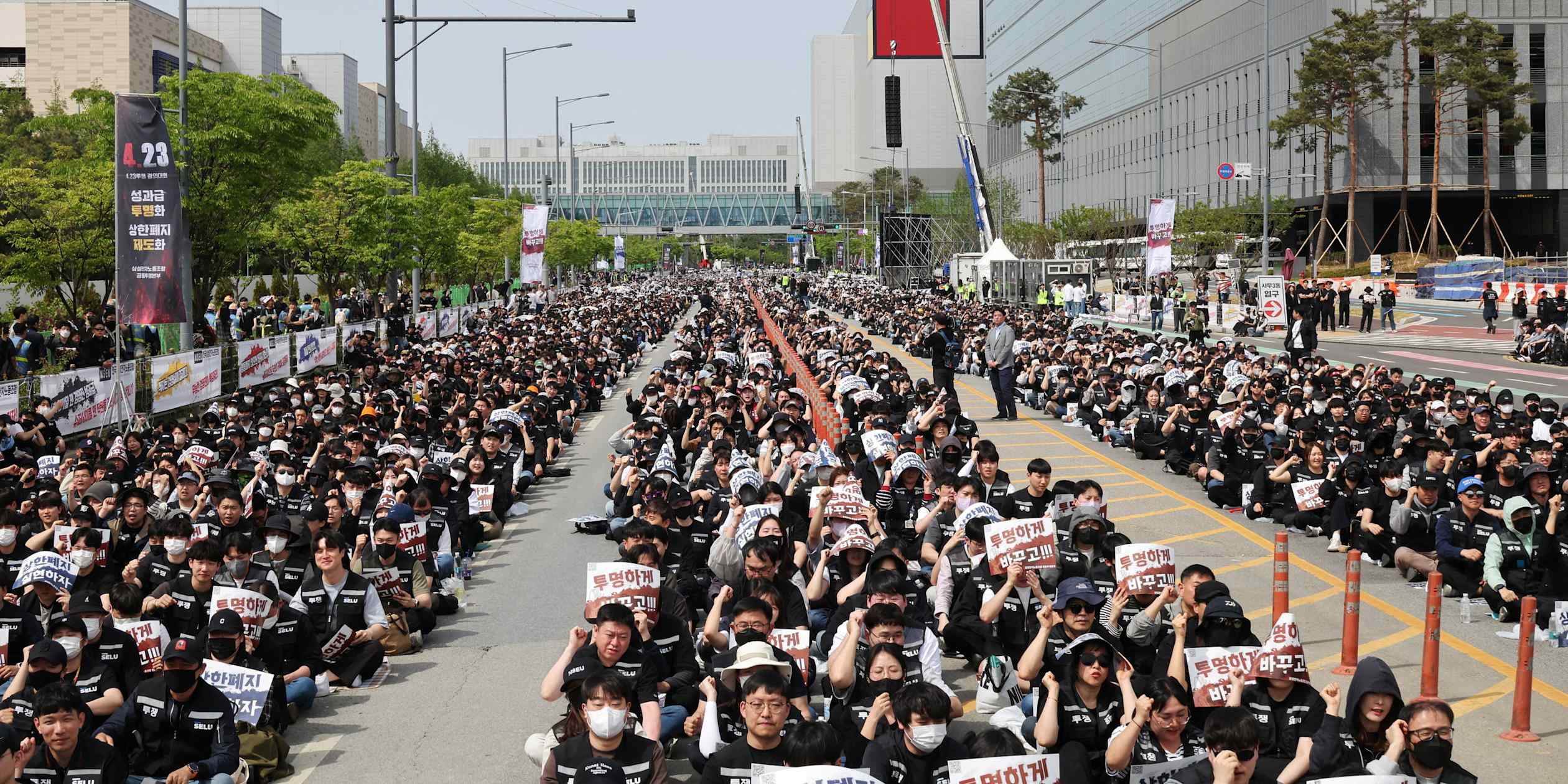
Samsung Electronics and its largest union failed to reach a wage agreement Wednesday after two days of government-mediated talks in Sejong, South Korea. More than 41,000 workers are now expected to begin an 18-day strike on May 21. The dispute centers on performance bonuses: Samsung caps its bonus pool while rival SK Hynix restructured last year to share a direct percentage of operating profits with workers. Samsung lost $66 billion in market value within hours of the breakdown before South Korean Prime Minister Kim Min-seok convened emergency ministerial talks and pledged government support to avert a walkout.
Samsung's bonus standoff is really a dispute about whether workers who helped produce the chip that powers the AI boom are entitled to a share of the margins -- and the government is terrified that a yes would cascade through the entire Korean industrial economy.
The Hidden Bet
A Samsung strike would materially disrupt global chip supply
Samsung has been losing market share in leading-edge logic chips to TSMC for years. Its Pyeongtaek fabs are critical for DRAM and NAND, but TSMC's fabs are not involved. The strike would hurt Samsung's balance sheet and speed up customer diversification -- but the global chip shortage risk is concentrated in memory, not the logic chips that matter most for AI inference.
The South Korean government can successfully prevent the strike through arbitration
A compulsory arbitration order or injunction would be politically explosive and legally contested. Using state power to block a legal strike at a private corporation sets a precedent that other unions -- at Hyundai, LG, SK -- will test immediately.
This is a Korea-specific labor dispute
The SK Hynix profit-sharing model -- which triggered the Samsung comparison -- is being watched by chip workers in the US, Japan, and Taiwan. If it becomes standard at Korean fabs, it creates pressure on TSMC and Intel to match it or face their own organizing pressure.
The Real Disagreement
The core tension is between Samsung's management insisting on cost predictability to sustain R&D investment in next-generation chips, and workers insisting that the people who built the competitive advantage share in it when it pays off. You cannot fully have both: guaranteed profit-sharing raises Samsung's cost base in down cycles, when it needs capital to catch TSMC. But denying workers a share of the AI chip boom while Samsung executives receive performance bonuses is a credibility problem that will degrade long-term retention of the engineers Samsung needs most. The union's position is more defensible in isolation; Samsung's position is more defensible given what it would need to spend over the next five years to close its technology gap.
What No One Is Saying
Samsung's real vulnerability here is not the strike -- it is that the engineers who matter most for advanced process technology are not the 41,000 union workers at risk of striking. They are the 5,000 researchers and process engineers who are not in the union, are already being recruited by TSMC and SK Hynix, and are watching this dispute as a signal about whether Samsung values technical talent.
Who Pays
Samsung union workers
Immediately, starting May 21 if no deal is reached
An 18-day strike means 18 days of lost wages. Even if they win the bonus dispute, the cost of the walkout often exceeds the gains for individual workers in the first year
Samsung DRAM and NAND customers -- including Apple, hyperscalers, PC makers
6-8 weeks after a strike begins, when inventory buffers are exhausted
A prolonged strike at Pyeongtaek creates spot price volatility in memory markets and could accelerate customer shift to SK Hynix and Micron for new contracts
South Korean government and ruling party
Political cost materializes within weeks; electoral impact over 12 months
If Seoul uses emergency arbitration to block a legal strike, it hands the opposition a labor-suppression narrative heading into the next election cycle
Scenarios
Last-minute deal
Samsung agrees to a partial profit-sharing mechanism with a floor and cap, framed as a 'performance incentive review' rather than the SK Hynix model. Strike is averted. Both sides declare partial victory.
Signal Union chair agrees to a 48-hour extension of talks within 5 days of the May 21 deadline
18-day strike proceeds
Workers walk out May 21. Memory spot prices spike 8-12% within two weeks. Samsung management holds firm, betting the union cannot sustain a full 18-day walkout with lost wages. Strike ends in less than two weeks without a deal.
Signal No further mediation sessions scheduled by May 18 and no government injunction filed
Government forces arbitration
Seoul invokes compulsory arbitration, legally blocking the strike. Samsung avoids short-term disruption. The union challenges the order in court. Broader Korean labor movement unifies against the government.
Signal Emergency cabinet session convened within 3 days; legal filings by union within 24 hours of any arbitration order
What Would Change This
If Samsung announces it is accelerating chip manufacturing investment in the US or Japan -- moving production capacity offshore -- the domestic labor dynamics shift: workers lose the leverage that comes from Samsung needing Korean fabs to compete.
Related
Samsung Workers Want 15% of the AI Boom. Management Says the Company Can't Afford It.
conflictSamsung's Workers Want 15% of the AI Boom. The Company Says No. An 18-Day Strike Starts May 21.
conflictSamsung's Record Quarter Is Funding Its Own Undoing
powerSamsung's Workers Want Their Cut of the AI Boom