Samsung's Semiconductor Boom Is Tearing Its Union Apart
What happened
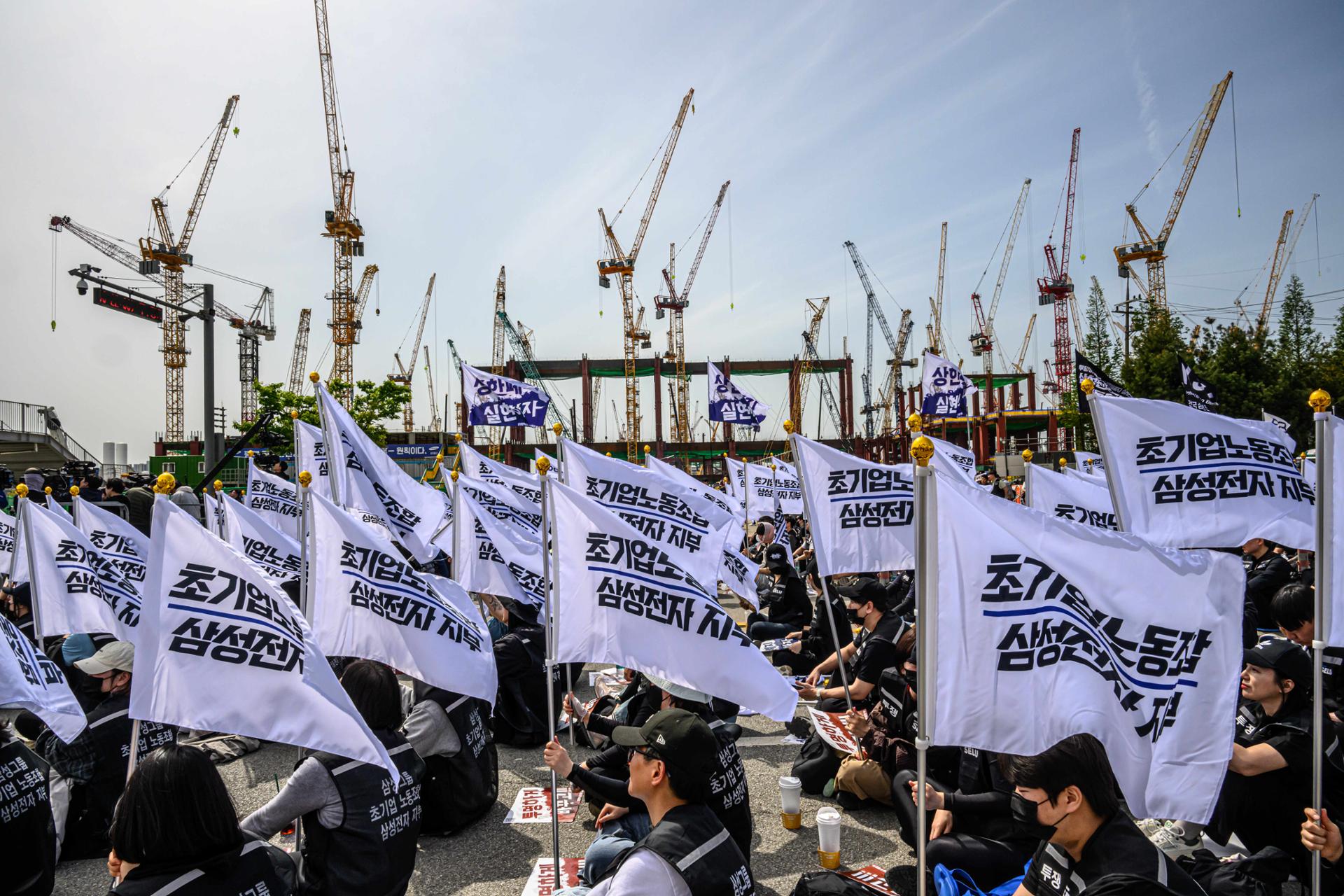
Samsung Electronics' majority union, the Super Corporate Labor Union, has been planning a mass strike over performance bonuses, demanding that 15% of operating profit be used as a bonus fund. The demand is driven by the semiconductor division's AI-era profits: Samsung's chip business generated record revenues from HBM memory demand. But more than 2,500 non-chip Samsung workers, those in mobile devices, consumer electronics, and other divisions, have quit the union in the 10 days through May 3. A third union body, Donghaeng, formally withdrew from the joint strike coalition. Non-chip workers say the strike demand benefits only chip workers and that the operating-profit bonus structure would permanently entrench pay inequality between divisions. Analysts warn that if the strike proceeds, it risks disrupting HBM supply at a moment when Samsung is already losing market share to SK Hynix.
Samsung's AI-era profits have created a structural pay inequality within its own workforce that a single union structure cannot contain, and the strike meant to claim those profits is destroying the coalition before it starts.
The Hidden Bet
The union represents a unified Samsung workforce with shared interests.
Samsung's semiconductor division and its consumer electronics division are economically different companies sharing a brand and HR system. The chip division runs on AI-cycle capital intensity and can generate margins that justify aggressive bonuses. The mobile division competes on consumer spending cycles with much lower margins. An operating-profit bonus structure that is fair for chip workers is structurally unfair for everyone else at the same company.
A union fracture strengthens Samsung's management position.
If the strike coalition dissolves, the chip workers may pursue a separate, focused walkout rather than a company-wide one. A chip-only strike would hit exactly the HBM supply that is Samsung's most strategically sensitive product. Disaggregated action could be more damaging to Samsung's supply chain than the joint strike the coalition was planning.
This is a Korean labor story with limited global implications.
Samsung supplies a substantial portion of global HBM memory, which is the high-bandwidth memory used in Nvidia's AI chips. A sustained strike disrupting HBM production would propagate through the AI data center supply chain within weeks, affecting Nvidia's ability to ship GPUs and raising data center costs globally.
The Real Disagreement
The real tension is between two legitimate claims: chip workers created the value and should share in it proportionally, and workers in the same company should not be permanently stratified by which division happens to be in a technology cycle upswing. Both of these are defensible. They are also incompatible within a single operating-profit bonus structure. The union chose the chip workers' framing. The non-chip workers are leaving because that choice was made for them without their consent. This is the AI economy distributing its rewards within a single organization, and the losers are the workers in the same building who happened to be assigned to the wrong product line.
What No One Is Saying
Samsung management is not a passive party in this fracture. A divided union is easier to negotiate with than a unified one. The non-chip workers' departure gives Samsung management a credible argument that the strike demand lacks majority support. The timing of union exits, correlated with management's public framing of the demands as unfair to the broader workforce, is not coincidental.
Who Pays
Samsung non-chip workers
Ongoing: the gap compounds with each fiscal year that the chip division outperforms.
A strike that only proceeds if chip workers lead it, on a demand that primarily benefits chip workers, leaves non-chip employees with no leverage and no representation in the outcome. If the bonus structure is implemented as demanded, non-chip workers at Samsung face a permanent earnings gap that grows with every AI market cycle.
AI data center operators globally
Within 4-6 weeks of any sustained strike hitting chip fabrication lines.
A prolonged strike by Samsung's semiconductor division would restrict HBM supply to Nvidia and other GPU manufacturers. HBM is already a constrained market. A supply disruption would delay AI infrastructure buildout and increase chip prices.
Scenarios
Coalition collapses, no major strike
Non-chip union exits continue until the joint strike coalition lacks the membership to credibly execute a company-wide action. Chip workers negotiate separately with management, reach a compromise bonus that is less than 15% of operating profit, and the broader structural inequality question goes unresolved.
Signal Watch for the Super Corporate Labor Union reporting membership below 50,000 (from a prior peak above 55,000) and a management announcement of 'productive talks.'
Chip workers strike alone
The fracture produces a leaner, chip-focused strike with more targeted disruption potential. Samsung's HBM fab lines see a walkout timed to a quarterly production cycle, creating a measurable supply gap for AI memory.
Signal Watch for Nvidia and other HBM buyers issuing supply chain risk disclosures and Samsung's chip division union filing formal strike notice.
National arbitration imposes settlement
The Korean government, concerned about national industrial stability and Samsung's strategic importance, intervenes through the National Labor Relations Commission to impose a mandatory cooling-off period and structured arbitration, preventing any strike before the AI memory cycle peaks.
Signal Watch for government statements framing Samsung as 'strategic national infrastructure' and any emergency labor mediation filings.
What Would Change This
If Samsung management agreed to a two-tier bonus structure, one formula for chip workers and a separate formula for consumer electronics workers, the core fairness complaint would be addressed and the union fracture would likely stabilize. No such proposal has been made. The bottom line holds unless the company is willing to formally acknowledge that it is running two different businesses under one labor agreement.
Related
Samsung Workers Want 15% of the AI Boom. Management Says the Company Can't Afford It.
powerSamsung's Workers Want Their Cut of the AI Boom
conflictSamsung Faces Its First Strike in 88 Years. Google, Apple, and Qualcomm Are Worried.
conflictSamsung's Workers Want 15% of the AI Boom. The Company Says No. An 18-Day Strike Starts May 21.