Google Just Paid $40 Billion for the AI Model That's Beating Its Own
What happened
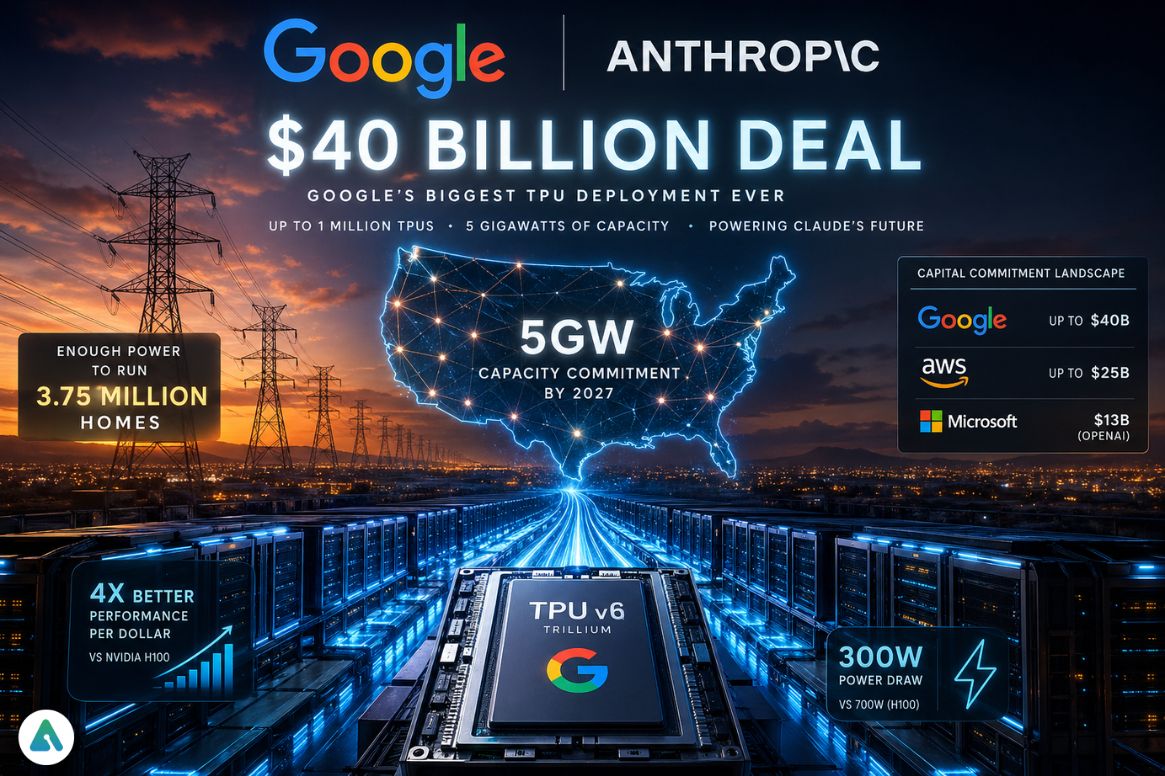
Google committed up to $40 billion to Anthropic, the largest single investment in frontier AI history. The deal is structured as $10 billion in cash at a $350 billion valuation, with an additional $30 billion contingent on performance milestones, plus five gigawatts of TPU compute capacity over five years. The announcement came days after Amazon had committed its own multi-billion dollar tranche. Claude, Anthropic's flagship model, is now outperforming Gemini in enterprise sales, the market Google considers its core.
Google is paying $40 billion to subsidize the product that is replacing its own, because the alternative is watching Amazon own the compute relationship with the winner.
Prediction Markets
Prices as of 2026-04-25 — the analysis was written against these odds
The Hidden Bet
Google can keep Anthropic neutral between Google Cloud and AWS while both are major investors
Anthropic needs the best compute deal, not the most balanced one. If AWS Trainium or TPU performance diverges, Anthropic will route workloads toward the better option regardless of who wrote the check.
Investing in a competitor is unusual and raises antitrust risk
Google already owns roughly 30 percent of Anthropic pre-deal. The DOJ's current theory of AI antitrust focuses on access exclusivity, not funding relationships. A deal where Google funds a model that runs on competitors' infrastructure may actually reduce antitrust exposure compared to vertical lock-in.
The $30B conditional tranche protects Google from overpaying
Performance milestones in AI deals are typically model benchmarks and revenue targets that Anthropic controls the definition of. Google has limited ability to claw back if the milestones are met on paper but Anthropic's market position deteriorates.
The Real Disagreement
The real fork is whether this deal makes Gemini more or less likely to survive as a serious enterprise product. One reading: Google keeps Anthropic inside the tent, extracts compute revenue via TPUs, and buys time to fix Gemini. The other: by legitimizing Claude with $40 billion and its own brand, Google accelerates enterprise customers' flight from Gemini to the model Google is now explicitly backing. The second reading is more likely. When you fund your competitor at a $350B valuation, you are telling every enterprise buyer that your competitor is worth $350 billion. That is not a hedge. That is a concession.
What No One Is Saying
The enterprise customers most aggressively adopting Claude are Google's own GCP clients. Google is subsidizing the acceleration of its own cloud customers switching to a rival model on Google's own infrastructure. The compute revenue is real. The strategic cost is also real, and no one at Google has publicly acknowledged the tension.
Who Pays
Gemini product team and Google DeepMind
Immediate and ongoing
Every dollar Google routes to Anthropic is a signal that the organization does not believe its own model can win enterprise alone. Internal morale and talent retention at DeepMind become harder to sustain when the company is publicly backing the competition.
OpenAI
Medium-term: enterprise contract cycles run 6-18 months
The deal cements Anthropic as the primary alternative to GPT-4-class models in enterprise, backed by effectively unlimited Google capital. OpenAI now competes against a player with $40B in committed funding and Google's distribution.
Startup AI model developers
Already underway; visible in funding rounds drying up below Tier 1
When Google and Amazon together anchor Anthropic's valuation at $350B, they set a capital barrier for any independent AI lab trying to compete on frontier model quality. The market is narrowing to players who can attract hyperscaler backing.
Scenarios
Compute colony
Anthropic becomes Google's most profitable TPU customer, running Claude workloads on Google infrastructure. Google earns margin on every Claude API call. Gemini fades in enterprise but Google doesn't care because the revenue is equivalent.
Signal Google stops reporting Gemini enterprise revenue as a standalone metric in earnings calls
The $350B trap
Anthropic's valuation creates pressure to IPO or pursue exits at that level. The $30B conditional tranche never fully disburses because milestones drift. Google writes off the investment over five years as a failed hedge and accelerates Gemini 3.
Signal Anthropic misses a major performance milestone by Q4 2026 and publicly renegotiates terms
Antitrust breakup
DOJ or FTC opens a formal investigation into coordinated investment between Google and Amazon in the same frontier AI company. The structural concern: two hyperscalers jointly controlling the compute access and investor board of the leading independent AI lab.
Signal DOJ files civil investigative demand against Google or Amazon citing the Anthropic co-investment structure
What Would Change This
If Anthropic announces a new compute deal that exclusively or predominantly routes to AWS Trainium and away from Google TPUs, the investment thesis collapses. That would reveal Google bought equity without securing the infrastructure relationship that justified the price.
Related
Google Buys a Rival It Cannot Control
powerGoogle Just Paid $40 Billion for a Competitor It Also Supplies
powerThe Government Is Now Testing AI Models Before They Launch. The Companies That Designed the Tests Are the Same Ones Being Tested.
powerApple Just Ended ChatGPT's Exclusive Status. OpenAI Should Be Worried.